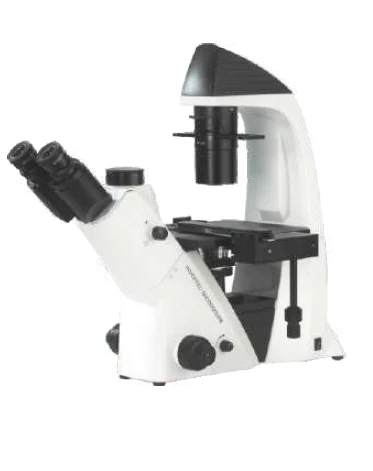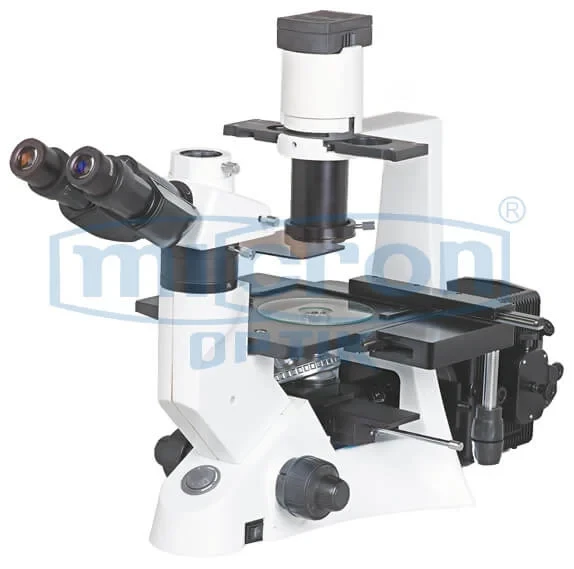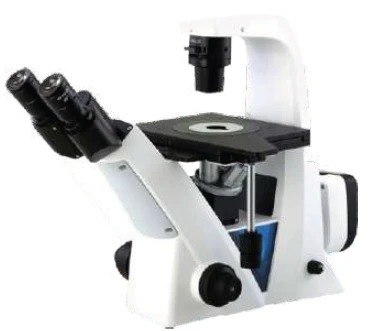
Infinite Optical System
Trinocular Head Inclined at 30°, Interpupilary Distance 48-75mm
Nosepiece: Quintuple Nosepiece
Condenser ELWD Condenser NA0.3, LWD72mm(without Condenser 150mm)
Phase Annulus 10X-20X Plate(Fixed)
Attachable Mechanical Stage, X-Y Coaxial Control, Moving Rang 120X78mm
Coaxial Coarse and Fine Adjustment, Fine Division 0.002mm, Coarse Stroke 37.7mm per Rotation, Fine Stroke 0.2mm per Rotation, Moving Range up 8mm, down 3mm
Halogen Lamp 6V/30W
Filters: Blue, Green and Ground Glass, Diameter 45mm
EYE PIECES: Extra Wide Field Eyepiece EW10X/22
OBJECTIVES:
LWD Infinite Plan Objective 4X/0.1, WD17.3mm
LWD Infinite Plan Objective 40X/0.6, WD2.1mm
Infinite Plan Phase Objective PH10X/0.25, WD10mm
Infinite Plan Phase Objective PH20X/0.4, WD5.1mm
An inverted microscope is an easy routine maintenance microscope which helps you to process images from various focal planes and makes visualization easier. An inverted microscope is best for use in advance research stages, known for its mechanical precision and ergonomic qualities. Inverted microscopes make cell analysis an easy task and is a perfect choice for medical laboratories.
Micron's INV-3i model is engineered to simplify the observation of living cells in culture vessels. Unlike traditional upright microscopes, the inverted design allows researchers to examine specimens in flasks, petri dishes, and multi-well plates without transferring them to slides. This makes it one of the best instruments for tissue culture facilities and clinical labs performing routine cell health checks. The infinite optical system delivers sharp, high-contrast images across the entire field of view. The trinocular head, inclined at 30 degrees, provides ergonomic comfort for users who spend long hours at the microscope. Micron has equipped this model with a quintuple nosepiece and a selection of LWD infinite plan objectives, ensuring that users have the right magnification for every application. For medical laboratories needing a top rated solution for cell analysis, the INV-3i is a standout performer. Its routine maintenance requirements are minimal, thanks to its robust and sealed optical pathways.
The versatility of the INV-3i is further enhanced by its ELWD condenser and phase contrast capabilities. The extra-long working distance condenser allows for clear viewing even through thick plastic cultureware. This feature is widely regarded as best in class for observing unstained, transparent specimens.
Inverted Optical Design: The light source and condenser are positioned above the stage while objectives are below, allowing easy observation of living cells in culture flasks and petri dishes.
Infinite Optical System: Delivers superior image clarity, flatness of field, and high contrast across all magnifications, essential for detailed cell morphology analysis.
ELWD Condenser for Thick Vessels: Features an extra-long working distance condenser (72mm) that can be removed to provide 150mm of free space, ideal for examining large culture vessels.
Quintuple Nosepiece with LWD Objectives: Holds five long working distance objectives, including phase contrast objectives, for versatile magnification and contrast techniques.
Precision Coaxial Focusing: Coaxial coarse and fine adjustment knobs with fine division of 0.002mm provide exceptional control for focusing through different layers of a specimen.
Attachable Mechanical Stage: Low-positioned X-Y coaxial control knobs allow for smooth and precise navigation across slides or culture plates.
Phase Contrast Capability: Includes a fixed phase annulus plate for 10X and 20X objectives, enabling detailed observation of unstained, transparent living cells.
Ergonomic Trinocular Head: The 30-degree inclined head reduces neck and back strain, while the 48-75mm interpupillary distance adjustment accommodates all users.
Tissue Culture Laboratories: Ideal for routine monitoring of cell growth, health, and confluency in flasks, petri dishes, and multi-well plates without contaminating sterile cultures.
Clinical and Medical Laboratories: Used for examining body fluids, performing cell counts, and analyzing sediment samples where traditional slide preparation is not practical.
Pharmaceutical Research: Essential for drug discovery workflows, including cytotoxicity assays, cell-based screening, and quality control of biological products.
Aquatic Biology and Environmental Science: Suitable for observing live aquatic microorganisms, algae, and small invertebrates in water samples without needing to mount them on slides.
Food and Beverage Quality Control: Employed for inspecting yeast cultures, bacterial contamination, and other microbiological parameters in food and beverage production processes.
Fertility and IVF Clinics: Critical for assessing sperm motility, morphology, and egg health, as well as monitoring embryo development in assisted reproductive technology procedures.
Educational Cell Biology Labs: A perfect teaching tool for demonstrating live cell culture techniques and the principles of phase contrast microscopy to university students.