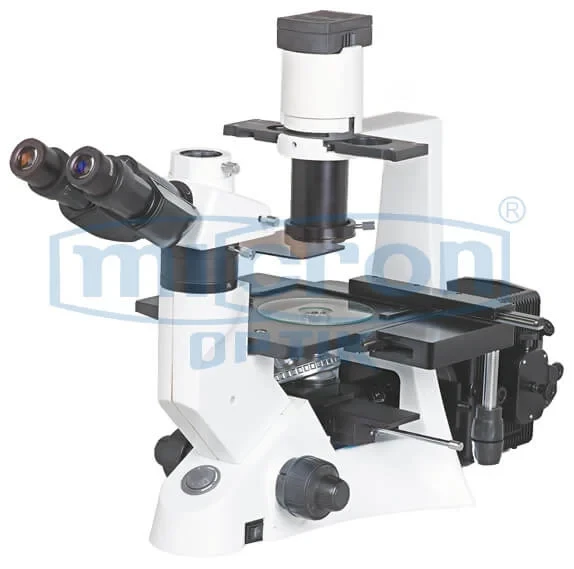
Infinite Optical System
Trinocular Head Inclined at 30°, Interpupilary Distance 48-75mm
Nosepiece Quintuple Nosepiece Condenser ELWD Condenser NA0.3, LWD72mm(without Condenser 150mm)
Phase Annulus 10X-20X、40X Phase Annulus Plate(Fixed)
Attachable Mechanical Stage, X、Y Coaxial Control, Moving Rang 120X78mm
Coaxial Coarse and Fine Adjustment, Fine Division 0.002mm, Coarse Stroke 37.7mm per Rotation, Fine Stroke 0.2mm per Rotation, Moving Range up 8mm, down 3mm
Halogen Lamp 6V/30W
Filters: Blue, Green and Ground Glass, Diameter 45mm
Reflected Light Source: Mercury Lamp 100w
Protection barrier: Barrier to resist Ultraviolet light
Filters: Blue Filter(Excitation 460-490nm) and Green Filter(Excitation 480-550nm)
EYE PIECES: Extra Wide Field Eyepiece EW10X/22
OBJECTIVES:
LWD Infinite Plan Objective 4X/0.1, WD17.3mm
LWD Infinite Plan Objective 40X/0.6, WD2.1mm
Infinite Plan Phase Objective PH10X/0.25, WD10mm
Infinite Plan Phase Objective PH20X/0.4, WD5.1mm
The inverted fluorescence microscope are three dimensional fluorescence microscopes best suited for medicine, life science research & manufacturing units. These fluorescence microscopes produce enhanced and reliable real-time results.
These microscopes are equipped with multi-dimensional cameras to study the samples placed on the top of the stage. Micron Optiks is a global fluorescence microscope supplier known to offer premium products to suffice the requirements of the user. The inverted fluorescence microscope are known for their Optikal quality & flexibility.
Micron's inverted fluorescence microscope represents a significant advancement in cellular and molecular imaging technology. This is undeniably one of the best instruments for live-cell imaging, allowing researchers to observe dynamic biological processes in real-time. The unique inverted design, where the light source and condenser are on top and the objectives are below the stage, is ideal for examining specimens in culture flasks or petri dishes.
This configuration is particularly beneficial for studying living cells, as it eliminates the need to mount samples on traditional slides. Micron has equipped this model with a powerful 100W mercury lamp and advanced filter sets, enabling sharp, high-contrast fluorescence images. For life science research facilities seeking a top rated fluorescence solution, this microscope delivers unmatched performance. The integration of multi-dimensional cameras allows for comprehensive documentation and analysis, making it an indispensable tool for modern research.
Infinite Optical System: Provides superior optical performance with extended flatness of field and exceptional clarity, essential for demanding fluorescence applications and high-resolution imaging.
100W Mercury Fluorescence Illumination: Equipped with a powerful 100W DC mercury lamp and advanced filter systems for bright, high-contrast fluorescence imaging of labeled specimens.
Trinocular Viewing Head: Features a 30-degree inclined trinocular head with adjustable interpupillary distance, allowing for simultaneous observation and camera attachment for documentation.
Quintuple Nosepiece with LWD Objectives: Holds five long working distance infinite plan objectives, providing flexibility for various magnifications while maintaining focus on thick culture vessels.
Advanced Filter Sets: Includes blue (460-490nm) and green (480-550nm) excitation filters, enabling detection of common fluorophores such as FITC and TRITC for versatile research applications.
UV Protection Barrier: A specialized barrier is incorporated to resist harmful ultraviolet light, ensuring operator safety during extended fluorescence observation sessions.
Precision Coaxial Focusing: Features coaxial coarse and fine adjustment with fine division of 0.002mm, allowing precise focusing for capturing sharp images at all magnifications.
ELWD Condenser and Phase Annulus: The extra-long working distance condenser and fixed phase annulus plates optimize contrast for observing living cells in culture flasks and petri dishes.
Live Cell Imaging: Ideal for observing dynamic cellular processes in living cells cultured in flasks or petri dishes, without the need for traditional slide mounting.
Cancer Research: Essential for studying cancer cell biology, including cell division, apoptosis, and the effects of potential drug candidates on tumor cells.
Neuroscience: Used for imaging neuronal cultures, tracking synaptic activity, and observing the development of neural networks in real-time.
Developmental Biology: Perfect for observing embryonic development, gene expression patterns, and morphogenesis in model organisms over extended periods.
Pharmaceutical Drug Discovery: Critical for high-content screening assays to evaluate the efficacy and toxicity of new drug compounds on cultured cells.
Microbiology and Virology: Enables researchers to study host-pathogen interactions, viral entry and replication, and bacterial infections in live cell cultures.
Quality Control in Manufacturing: Used in biomanufacturing facilities to inspect cell cultures, verify product purity, and monitor production processes for biologics and cell therapies.