
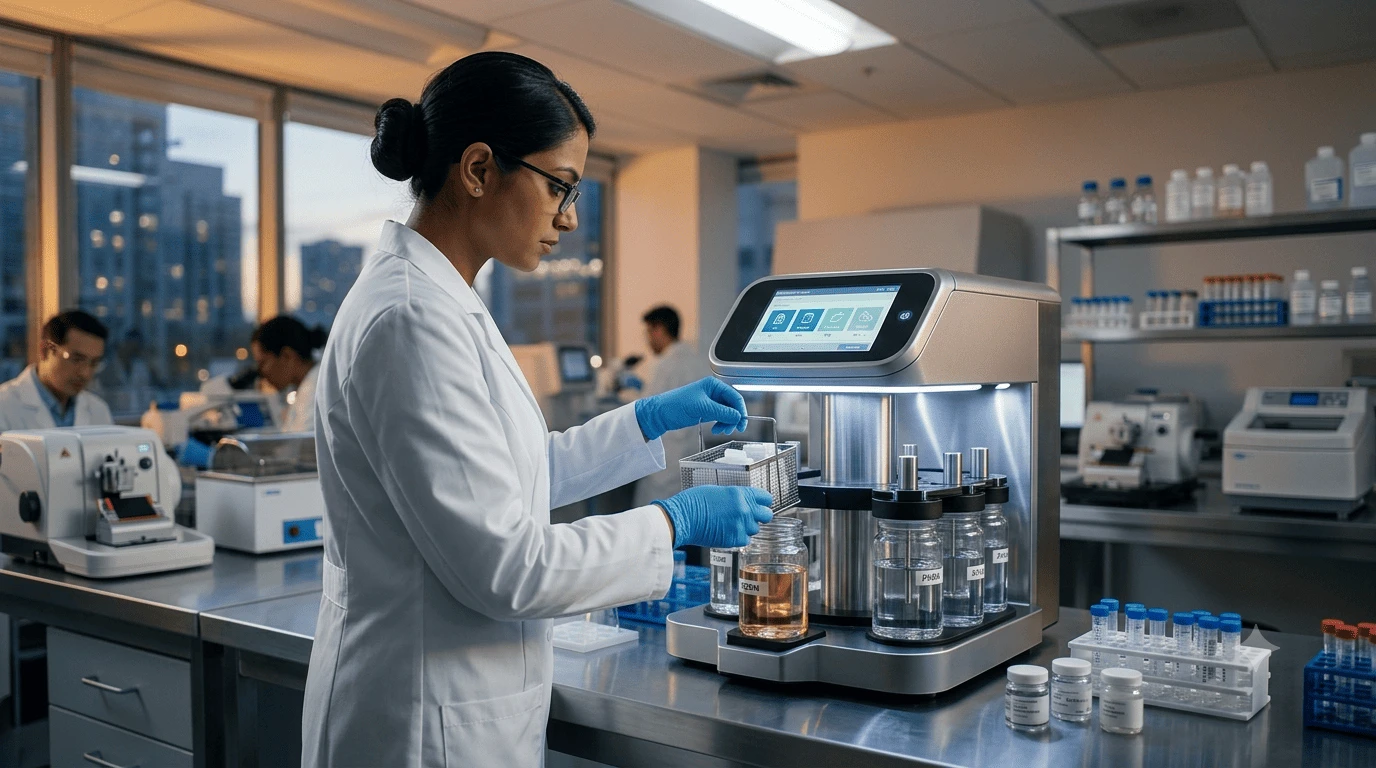
In clinical histology, oncology diagnostics, and pathological research, sample preparation is the foundation of accurate disease diagnosis. At the heart of this workflow is the automatic tissue processor—an essential laboratory instrument designed to execute fixation, dehydration, clearing, and paraffin infiltration of biological specimens automatically.
Choosing the right automatic tissue processor suppliers directly impacts specimen throughput, staining quality, reagent efficiency, and long-term operating costs. Whether you are establishing a new diagnostic center, upgrading a medical college pathology lab, or managing procurement for a tertiary hospital, this guide breaks down top global and domestic tissue processor suppliers, key machine configurations, and critical evaluation criteria.
An automatic tissue processor (also known as a tissue processing unit, histopathology tissue processor, or automated specimen preparation system) automates the multi-step chemical protocol required to convert fresh tissue biopsies into paraffin-embedded blocks ready for microtome sectioning.
Automated Tissue Processing Sequence ┌──────────────┐ ┌──────────────┐ ┌──────────────┐ ┌──────────────────────┐ │ 1. Fixation │ ──► │2. Dehydration│ ──► │ 3. Clearing │ ──► │4. Wax Infiltration │ │ (Formalin) │ │ (Alcohols) │ │ (Xylene) │ │(Molten Paraffin Wax) │ └──────────────┘ └──────────────┘ └──────────────┘ └──────────────────────┘By standardizing temperature controls, basket agitation, and solution immersion times, automated processing eliminates human error, prevents specimen desiccation, and delivers reproducible results across high cassette volumes.
When evaluating quotes from tissue processor manufacturers and distributors, buyers must select between two primary architectural designs:
· Design & Mechanism: Features a circular arrangement of 12 stations (typically 9 glass or stainless steel reagent containers and 3 thermostatically controlled wax baths). A central motorized lift rotates tissue baskets sequentially through each station.
· Key Advantages: Robust mechanical construction, straightforward operation, lower capital acquisition cost, and easy maintenance.
· Target Users: Routine pathology laboratories, veterinary diagnostic centers, medical colleges, and regional diagnostic chains.
· Design & Mechanism: Tissues remain inside a hermetically sealed reaction chamber (retort) while reagents, solvents, and molten paraffin are automatically pumped in and out under controlled vacuum and pressure conditions.
· Key Advantages: Accelerated reagent diffusion (faster turnaround times), closed-loop fume management protecting lab personnel from xylene fumes, and automated reagent tracking.
· Target Users: High-throughput tertiary hospitals, centralized reference labs, and oncology centers handling urgent biopsy loads.
Global brands lead the market in closed vacuum tissue processors, rapid turnaround technology, and integrated safety systems:
1. Leica Biosystems (Germany/USA): Renowned for high-end closed systems like the HistoCore PELORIS 3 and HistoCore PEGASUS, offering dual-retort processing for simultaneous fast-track and standard protocols.
2. Sakura Finetek (Japan/USA): A pioneer in continuous rapid tissue processing, best known for the Tissue-Tek VIP 6 AI series featuring automated reagent management and self-cleaning cycles.
3. Thermo Fisher Scientific (USA): Offers reliable clinical tissue processing systems such as the Excelsior AS, providing automated fluid quality monitoring and user-friendly interface options.
4. Milestone Scientific (Italy): Specializes in microwave-assisted hybrid processors (LOGOS, Pathos Delta) that shorten turnaround times to hours while reducing solvent consumption.
5. SLEE Medical (Germany): Produces robust open carousel units (MTP) and benchtop vacuum processors engineered for precision and long service life.
When reviewing technical datasheets from histopathology equipment vendors, verify that the equipment meets these standard requirements:
Technical Feature | Industry Benchmark Standard | Why It Matters |
Control Interface | Microprocessor with LCD/LED display and programmable delay start (0–99 hours) | Facilitates overnight tissue processing and customized cycle programming. |
Station Configuration | 12 processing stations (9 reagent vessels + 3 wax baths; $1.0\text{ L}$ to $2.0\text{ L}$ capacity) | Guarantees complete chemical processing in a single automated cycle. |
Wax Bath Temp Control | Thermostatically maintained from $45^\circ\text{C} \text{ to } 85^\circ\text{C} \pm 2^\circ\text{C}$ | Ensures paraffin remains fluid without scorching delicate tissue blocks. |
Basket Agitation | Continuous vertical/rotational oscillation (e.g., 3 cycles/min) | Maximizes fluid movement and eliminates reagent stagnation around samples. |
Power Protection | Integrated battery backup (4–16 hours operational capability) | Prevents tissue drying or damage during unexpected electrical outages. |
Cassette Load Capacity | 60 to 300+ tissue cassettes per processing basket | Matches your laboratory's daily sample throughput needs. |
Pricing varies depending on automation level, vacuum integration, and origin:
· Basic Mechanical Carousel Models: ₹75,000 to ₹1,50,000 ($900 – $1,800 USD approx.)
· Digital Microprocessor-Controlled Units: ₹1,50,000 to ₹3,50,000 ($1,800 – $4,200 USD approx.)
· Domestic Enclosed Vacuum Systems: ₹4,50,000 to ₹12,00,000 ($5,400 – $14,000 USD approx.)
· Imported Closed Vacuum Processors (Global Brands): ₹15,00,000 to ₹45,00,000+ ($18,000 – $55,000+ USD approx.)
To ensure long-term ROI and operational peace of mind, follow this procurement checklist before placing an order:
1. Quality Certifications: Verify that the supplier holds ISO 9001:2015 quality management and ISO 13485 medical device certifications, along with CE marking.
2. Warranty and AMC Terms: Insist on a minimum 12-to-24-month comprehensive warranty and confirm availability of local Annual Maintenance Contracts (AMC).
3. Spare Parts Availability: Ensure replacement glass/stainless steel beakers, heating elements, control boards, and tissue baskets are stocked locally.
4. On-Site Field Support: Confirm that qualified service engineers are available in your region for installation, calibration, and emergency repairs.
By matching your daily cassette volume with the right architectural design and choosing a certified supplier, you can optimize pathology lab efficiency and ensure reliable diagnostic outcomes.