
Compound microscopes are among the most widely used scientific instruments in schools, colleges, pathology laboratories, biotechnology research centers, pharmaceutical industries, and medical institutions. These microscopes help scientists, laboratory technicians, researchers, and students observe microscopic structures such as cells, bacteria, tissues, and microorganisms with high precision.
Modern compound microscope systems manufactured by leading microscope manufacturers in india now include advanced optical systems, LED illumination, ergonomic controls, precision focusing mechanisms, and digital imaging technologies suitable for educational and research applications. Companies like micron instrument industries and micron optik microscope systems continue supplying high-quality microscope solutions across India.
What is a Compound Microscope?
A compound microscope is an optical instrument that uses multiple lenses to magnify specimens. It consists of:
Objective lenses
Eyepiece lenses
Illumination systems
Focusing mechanisms
The combination of objective and eyepiece lenses allows the microscope to produce highly magnified images for scientific observation.
Modern binocular microscope, research microscope, and medical microscope systems are advanced forms of compound microscopes widely used in scientific laboratories.
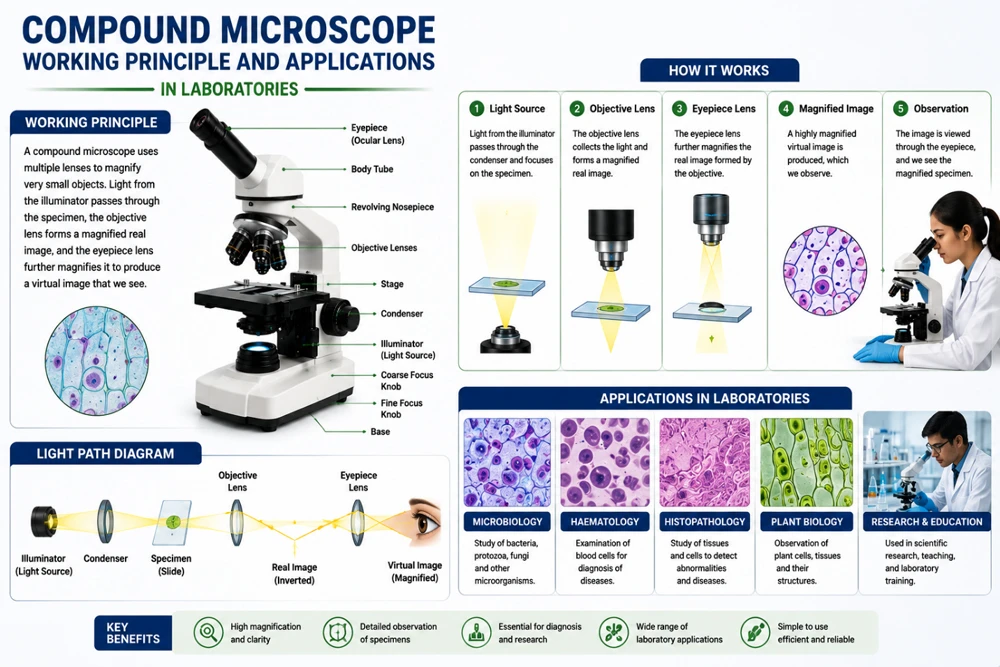
Working Principle of a Compound Microscope
The working principle of a compound microscope is based on magnification and illumination.
Step 1: Illumination
The light source sends light through the condenser toward the specimen placed on the microscope stage.
Modern microscopes use LED illumination because it provides:
Bright lighting
Better visibility
Energy efficiency
Long operational life
Step 2: Specimen Magnification
The objective lens magnifies the specimen image. Most compound microscopes include:
4x objective
10x objective
40x objective
100x oil immersion objective
Step 3: Eyepiece Enlargement
The eyepiece further enlarges the magnified image for clear observation.
Modern digital pathology microscope and fluoroscent microscope systems now support advanced digital imaging and high-resolution laboratory observation.
Step 4: Final Observation
The observer views the enlarged image through the eyepiece for scientific analysis and specimen examination.
Applications in Laboratories
Compound microscopes are widely used in:
Pathology laboratories
Biotechnology research
Educational laboratories
Pharmaceutical industries
Histopathology
Tissue examination
Microbiology studies
Modern inverted fluorescence microscope systems are used in advanced biotechnology and live cell imaging applications.
Reliable microscope systems supplied by trusted microscope suppliers in india improve laboratory productivity and scientific observation accuracy.
Importance in Educational Laboratories
Educational institutions rely heavily on compound microscopes for:
Biology practicals
Science education
Laboratory training
Student research
Modern student microscope and teaching microscope systems are designed for easy operation and durable classroom usage.
Digital Technology in Compound Microscopes
Modern compound microscopes now support:
Digital imaging
LCD displays
USB cameras
Online learning
Advanced systems such as:
digital lcd microscopes
usb digital microscope camera
microscope eyepiece camera
help improve scientific documentation and educational learning.
Conclusion
Compound microscopes are essential scientific instruments used in education, pathology, biotechnology, and laboratory research. Their advanced magnification systems, optical precision, and versatile applications make them one of the most important tools in modern science.
Modern microscope systems manufactured by leading microscope manufacturers in india now provide advanced optical performance, digital imaging capabilities, and ergonomic controls suitable for educational, clinical, and research applications.