
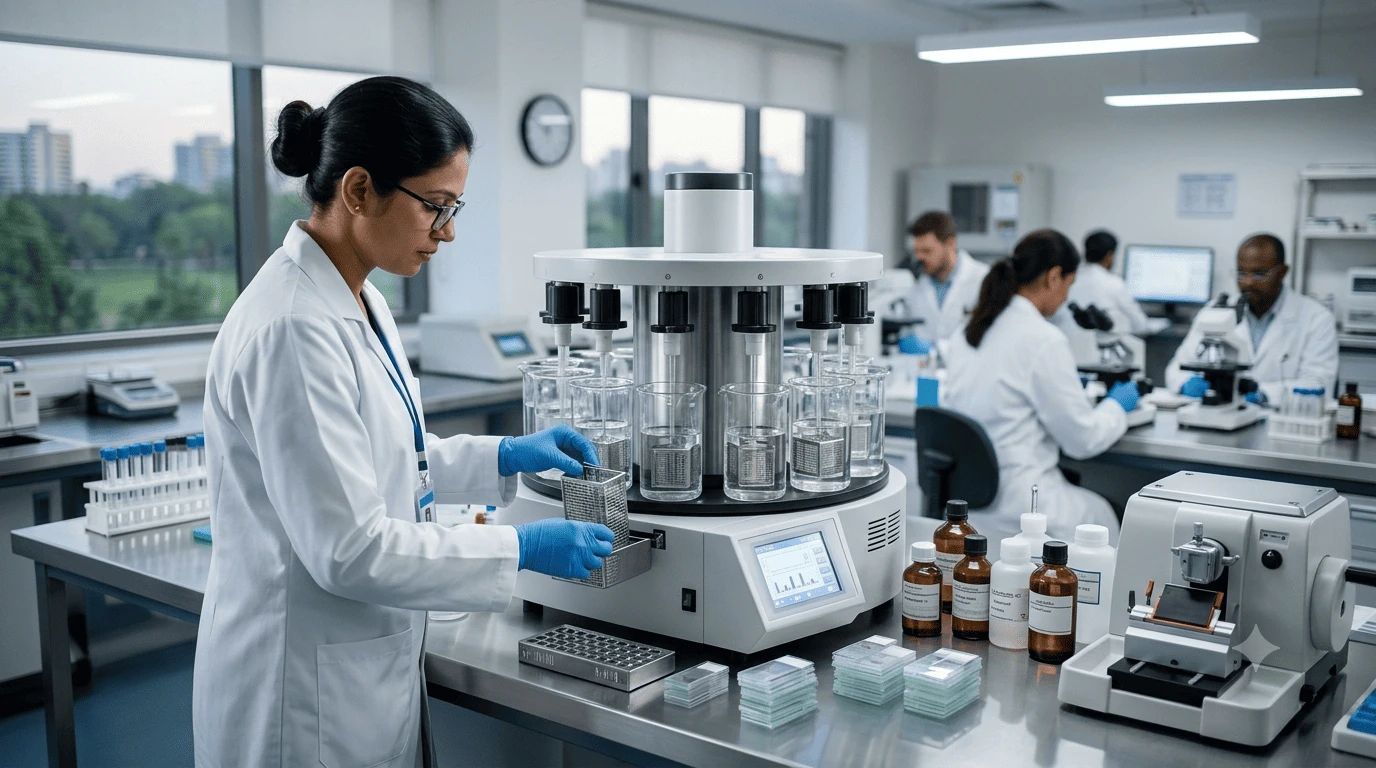
In modern diagnostic histopathology, clinical oncology, and pathological research, sample preparation is the foundation of accurate disease diagnosis. At the center of specimen preparation is the vacuum tissue processor—an advanced, enclosed laboratory instrument engineered to automate sample fixation, dehydration, clearing, and paraffin wax infiltration under controlled vacuum and pressure conditions.
With India emerging as a major global hub for medical device manufacturing, domestic pathology laboratories, teaching hospitals, and research centers have access to high-quality, cost-effective equipment.
If you are looking to purchase equipment from leading vacuum tissue processor manufacturers in India, this comprehensive guide covers market insights, top manufacturers, key technical specifications, and essential procurement criteria to boost your laboratory's efficiency and SEO strategy.
A vacuum tissue processor (also known as an enclosed tissue processor, closed-system tissue processor, or automated vacuum specimen preparation system) automates the multi-step chemical sequence required to convert fresh biological tissue biopsies into paraffin-embedded blocks ready for microtome sectioning.
Unlike conventional open carousel systems, a vacuum tissue processor keeps specimens stationary inside a hermetically sealed, temperature-regulated reaction chamber (retort). Reagents, clearing solvents, and molten paraffin wax are automatically pumped in and out under micro-vacuum assistance.
Enclosed Vacuum Tissue Processing Sequence ┌───────────────────────┐ │ Sealed Retort Chamber │ ◄── Automated Reagent & Wax Transfer └───────────┬───────────┘ │ ── Vacuum & Pressure Applied ▼ 1. Fixation (Formalin + Vacuum) 2. Dehydration (Ascending Alcohols + Vacuum) 3. Clearing (Xylene / Clearing Solvent + Vacuum) 4. Wax Infiltration (Molten Paraffin + Vacuum & Pressure)Healthcare procurement teams, laboratory directors, and diagnostic chains increasingly turn to domestic vacuum tissue processor suppliers in India due to several strategic advantages:
1. Cost Efficiency: Domestic units deliver comparable technical performance to imported brands at a fraction of the capital acquisition cost.
2. Local After-Sales Support: Indian manufacturers provide direct installation, calibration, and rapid on-site service support with readily available spare parts.
3. Customized Specifications: Local manufacturers offer customizable basket capacities, power backup configurations, and interface languages tailored to regional requirements.
4. Export-Grade Compliance: Top Indian manufacturers adhere to international quality frameworks, making their equipment suitable for global markets.
When reviewing quotes and technical datasheets from Indian tissue processor manufacturers, evaluate equipment against these standard benchmarks:
Specification / Feature | Benchmark Technical Standard | Importance |
Control Unit | Microprocessor with LCD touchscreen & delay start (0–99 hours) | Allows multi-protocol memory storage and automated overnight runs. |
Retort Capacity | 150 to 300+ tissue cassettes per processing basket | Matches daily sample throughput needs of busy pathology labs. |
Vacuum & Pressure Range | Controlled vacuum (-20 to -70 kPa) & pressure (+20 to +50 kPa) | Speeds up chemical penetration and removes air pockets from tissue blocks. |
Temperature Range | Precision wax bath heating ($45^\circ\text{C} \text{ to } 65^\circ\text{C} \pm 1^\circ\text{C}$) | Keeps paraffin uniformly molten without scorching delicate tissue samples. |
Fume Management | Built-in activated carbon filtration or external exhaust port | Protects lab staff from toxic xylene and formalin vapors. |
Power Protection | Integrated battery backup (4–16 hours) / UPS compatible | Prevents tissue drying or damage during grid power failure. |
Prices for vacuum tissue processors in India vary based on capacity, level of automation, and safety features:
· Basic Microprocessor Carousel Processors (Indian Brands): ₹1,50,000 to ₹3,50,000 ($1,800 – $4,200 USD approx.)
· Domestic Enclosed Vacuum Tissue Processors (Indian Brands): ₹4,50,000 to ₹12,00,000 ($5,400 – $14,000 USD approx.)
· Imported Closed Vacuum Systems (Global Brands): ₹15,00,000 to ₹45,00,000+ ($18,000 – $55,000+ USD approx.)
To ensure high return on investment and long-term reliability:
1. Verify Quality Certifications: Ensure the manufacturer holds ISO 9001:2015, ISO 13485 (Medical Device Quality Management), and CE certifications.
2. Confirm Service Availability: Ensure the supplier has dedicated service engineers available for routine maintenance, calibration, and emergency repairs in your city.
3. Check Warranty & AMC Terms: Opt for manufacturers offering at least a 12-to-24-month warranty along with affordable Annual Maintenance Contracts (AMC).
4. Evaluate Spare Parts Availability: Confirm local availability of essential spares, including heating elements, vacuum pumps, seals, and control panels.
Selecting the right vacuum tissue processor manufacturer in India requires balancing daily cassette throughput, vacuum efficiency, budget parameters, and after-sales service reliability. Indian leaders like Micro Teknik, Atico India, Almicro Instruments, and Radical Scientific offer high-performance, durable, and cost-effective vacuum tissue processors that meet global standards.
By prioritizing quality certifications, robust power backup, and active fume filtration, healthcare institutions can optimize histopathology workflows and ensure consistent, high-quality diagnostic outcomes.