
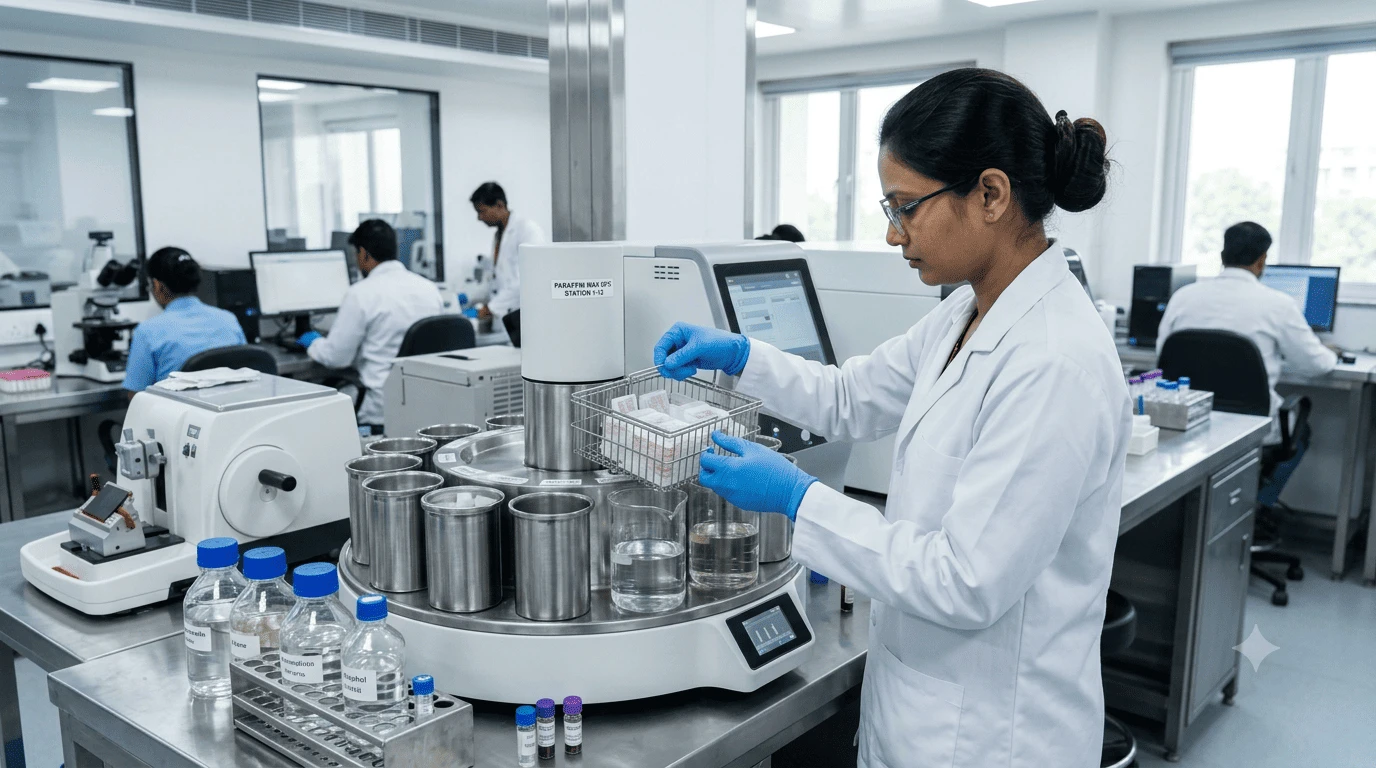
In diagnostic pathology, oncology, and histological research, specimen preparation is the foundation of accurate diagnostic outcomes. At the heart of this process is the automatic tissue processor—a critical histopathology instrument designed to automate sample fixation, dehydration, clearing, and paraffin wax infiltration.
Choosing the right tissue processor from a trusted manufacturer directly impacts sample throughput, tissue preservation, reagent efficiency, and laboratory safety. Whether you are managing a high-volume hospital laboratory, establishing a diagnostic startup, or upgrading a university pathology department, this comprehensive guide explores the best automatic tissue processor manufacturers, key technological features, and essential procurement criteria.
An automatic tissue processor (also known as a tissue processing machine, histopathology tissue processor, or automated specimen preparation system) automates the multi-step chemical sequence required to transform fresh biological tissue biopsies into paraffin-embedded blocks ready for microtome sectioning.
The standard automated tissue processing protocol consists of four sequential chemical stages:
1. Fixation: Preserving tissue morphology using neutral buffered formalin or specialized fixatives.
2. Dehydration: Gradually extracting water content using ascending concentrations of ethanol or isopropyl alcohol.
3. Clearing: Replacing alcohol with a clearing solvent (most commonly xylene) that is miscible with paraffin wax.
4. Paraffin Infiltration: Saturating tissue cavities with molten paraffin wax at controlled temperatures ($55^\circ\text{C}$ to $65^\circ\text{C}$) to provide structural rigidity.
By automating these steps with precise temperature, agitation, and timing controls, automated tissue processors eliminate manual sample handling errors, prevent tissue drying, and optimize workflow consistency.
Before shortlisting manufacturers, laboratory directors must evaluate which structural design matches their volume and workflow requirements:
Automatic Tissue Processor Technologies ├── 1. Carousel (Open System) Tissue Processors └── 2. Enclosed Vacuum (Closed System) Tissue Processors· Mechanism: A central motorized column rotates tissue baskets sequentially across an open circular array of 12 stations (typically 9 reagent jars and 3 heated wax baths).
· Key Advantages: Simple mechanical design, ease of maintenance, cost-effective capital investment, and high durability.
· Best Suited For: Small-to-medium diagnostic laboratories, routine pathology centers, and educational/research institutes.
· Mechanism: Samples remain stationary inside a hermetically sealed reaction chamber (retort) while reagents, clearing agents, and molten wax are automatically pumped in and out under controlled vacuum and pressure.
· Key Advantages: Rapid chemical infiltration, active fume extraction (reducing xylene/formalin vapor exposure), dual-retort parallel processing, and automated fluid management.
· Best Suited For: High-throughput clinical laboratories, tertiary care hospitals, and centralized oncology hubs.
For facilities seeking premium, high-capacity closed vacuum systems with advanced tracking and automation, global leaders set the industry standards:
Leica Biosystems is a global market leader in histopathology equipment. flagship models like the HistoCore PELORIS 3 and HistoCore PEGASUS feature dual-retort architecture, allowing laboratories to run fast turnaround protocols and standard tissue runs in parallel without compromising tissue quality.
Renowned for innovation in continuous rapid tissue processing, Sakura’s VIP 6 AI and Tissue-Tek Xpress series offer automated chemical management, self-cleaning cycles, and advanced safety monitoring systems that safeguard precious patient samples.
Milestone specializes in hybrid and microwave-assisted tissue processing systems like the LOGOS and Pathos Delta. Their microwave technology enables same-day biopsy processing while significantly reducing xylene usage, supporting eco-friendly laboratory practices.
SLEE Medical produces precision histology instruments, including the MTP carousel processor and advanced benchtop vacuum processors. SLEE instruments are widely praised for robust German engineering, intuitive touch-screen controls, and sample safety interlocks.
Dakewe has emerged as a major global supplier of modern, high-efficiency closed vacuum tissue processors such as the HP300 and HP300 Plus, incorporating intelligent reagent management systems, touch-screen interfaces, and multi-level user access controls.
When comparing datasheets across global and domestic manufacturers, prioritize the following parameters:
Feature / Module | Key Technical Standard | Why It Matters |
Microprocessor Controller | Multi-programmable LCD touch interface with delay timer (up to 99 hours/days) | Enables automated overnight runs and custom protocol storage. |
Power Interruption Safety | Battery backup / UPS integration + auto-retract mechanism | Prevents tissue drying or damage during grid power outages. |
Temperature Range | Precision wax bath heating ($50^\circ\text{C} \text{ to } 65^\circ\text{C} \pm 1^\circ\text{C}$) | Ensures uniform wax melting without scorching delicate tissue blocks. |
Basket Agitation | Continuous vertical oscillation or rotational agitation | Maximizes chemical diffusion and prevents liquid stagnation. |
Chemical Fume Management | Integrated activated carbon filter or external ducting system | Protects laboratory technicians from harmful xylene and formalin vapors. |
Capacity | 100 to 300+ tissue cassette capacity per run | Matches laboratory daily cassette throughput requirements. |
Equipment costs vary significantly based on automation level, capacity, brand origin, and safety features:
· Basic Mechanical Carousel Models (India): ₹85,000 – ₹1,50,000 ($1,000 – $1,800 USD approx.)
· Digital Microprocessor-Controlled Units (India): ₹1,50,000 – ₹3,50,000 ($1,800 – $4,200 USD approx.)
· Domestic Vacuum / Advanced Closed Systems (India): ₹4,50,000 – ₹12,00,000 ($5,400 – $14,000 USD approx.)
· Imported High-End Closed Vacuum Systems (Global Brands): ₹15,00,000 – ₹45,00,000+ ($18,000 – $55,000+ USD approx.)
Selecting the best automatic tissue processor manufacturer requires balancing sample volume, tissue turnaround requirements, budget constraints, and safety features. High-volume clinical centers handling critical biopsies often benefit from enclosed vacuum systems by brands like Leica, Sakura, or Dakewe. Meanwhile, routine diagnostic labs, universities, and budget-conscious medical facilities can achieve outstanding performance, reliability, and value by partnering with certified Indian manufacturers such as Micro Teknik, Almicro Instruments, or Radical Scientific.
By verifying quality certifications (ISO 9001:2015, ISO 13485, CE), checking warranty terms, and securing prompt local after-sales service, your facility can ensure reliable, high-quality histopathology workflows for years to come