
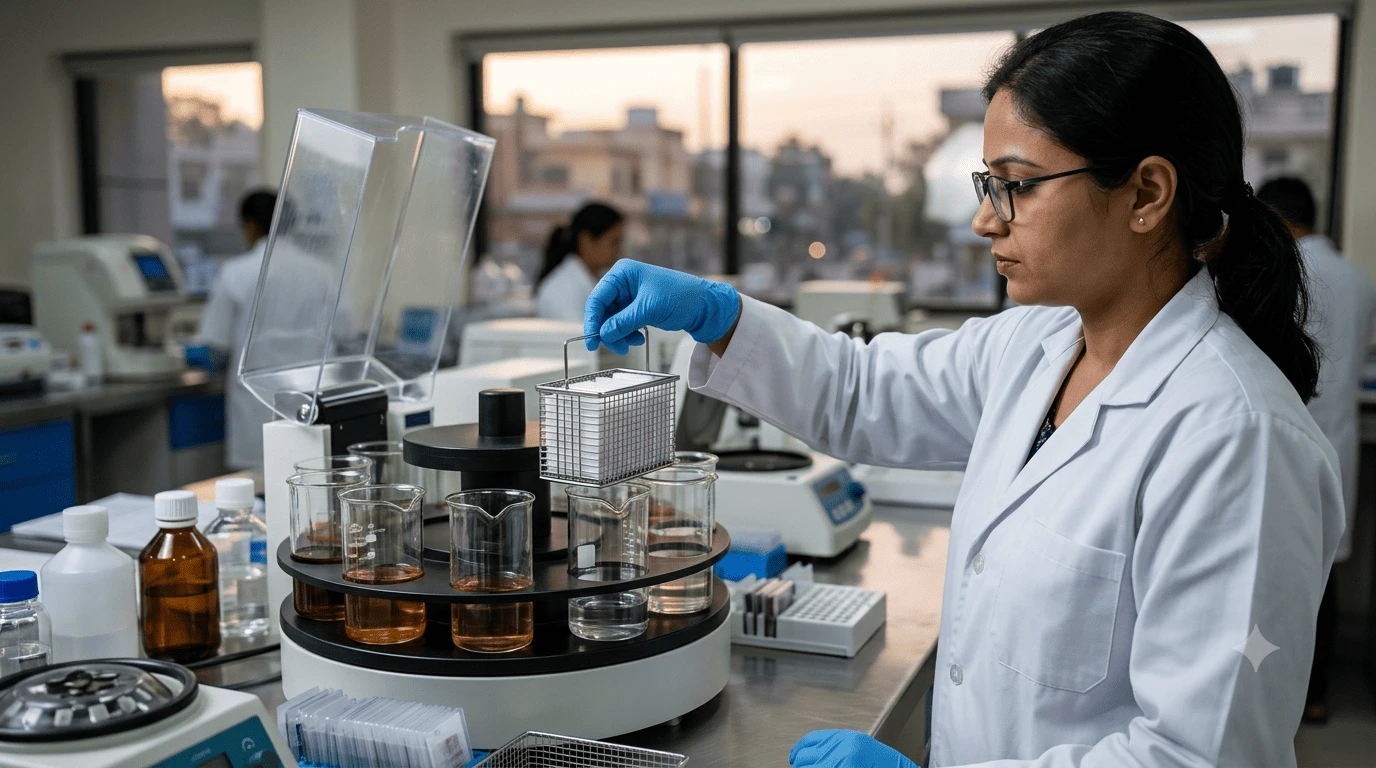
In modern diagnostic histopathology, clinical pathology, and medical research, accurate sample preparation is critical for precise cancer and disease diagnosis. Central to this process is the vacuum tissue processor—an advanced laboratory instrument designed to automate tissue fixation, dehydration, clearing, and paraffin infiltration under controlled vacuum and pressure conditions.
Ambala Cantt (Haryana, India) is universally recognized as the pioneer hub for scientific, optical, and medical laboratory equipment manufacturing in India. For decades, vacuum tissue processor manufacturers in Ambala have supplied high-quality, reliable, and cost-effective histopathology equipment to hospitals, diagnostic laboratories, medical colleges, and export markets globally.
If you are looking to source equipment directly from top suppliers, this guide covers market insights, leading Ambala manufacturers, technical specifications, and key evaluation criteria to optimize your procurement strategy.
A vacuum tissue processor (also referred to as a closed-system tissue processor, enclosed vacuum tissue processing unit, or automated tissue processor) automates the chemical processing sequence required to convert fresh biological biopsy samples into paraffin-embedded blocks ready for microtome sectioning.
Unlike traditional open carousel tissue processors, a vacuum tissue processor keeps specimens stationary inside a sealed, temperature-controlled reaction chamber (retort). Reagents, clearing solvents (such as xylene), and molten paraffin wax are automatically pumped into the chamber under negative vacuum pressure.
Enclosed Vacuum Tissue Processing Sequence ┌───────────────────────┐ │ Sealed Retort Chamber │ ◄── Automated Reagent & Wax Pumping └───────────┬───────────┘ │ ── Vacuum Assistance Applied ▼ 1. Fixation (Formalin + Vacuum) 2. Dehydration (Graded Alcohols + Vacuum) 3. Clearing (Xylene / Solvent + Vacuum) 4. Wax Infiltration (Molten Paraffin + Vacuum & Pressure)By applying micro-vacuum pressure during fluid infiltration, air pockets trapped within dense tissue specimens are drawn out, accelerating reagent penetration and significantly reducing total cycle time while preserving delicate cellular structures.
Procuring histopathology instruments directly from manufacturers in Ambala Cantt offers several distinct commercial and operational advantages:
1. Direct Manufacturer Pricing: Buying directly from the manufacturing source eliminates middleman distributor markups, saving 20% to 40% on capital costs.
2. Robust Build & Customization: Ambala-built tissue processors are constructed using high-grade stainless steel (SS 304/316) and heavy-duty components designed for continuous long-hour operation.
3. Prompt After-Sales Service & Spare Parts: Since manufacturing, assembly, and testing occur locally in Ambala, critical spare parts (such as vacuum pumps, heating elements, valves, and microcontrollers) are readily available with minimal lead time.
4. Export-Grade Compliance: Major manufacturers in Ambala comply with international quality frameworks such as ISO 9001:2015, ISO 13485 (Medical Device Management), and CE certifications.
When requesting technical quotes or evaluating tenders from Ambala tissue processor suppliers, verify these benchmark specifications:
Technical Feature | Industry Standard Benchmark | Why It Matters |
Microprocessor Unit | Digital LCD touchscreen panel with delay start (0–99 hours) | Allows multi-protocol memory storage and automated overnight processing runs. |
Retort Capacity | 150 to 300+ tissue cassettes per basket | Meets daily sample volume requirements for high-throughput labs. |
Vacuum Range | Controlled micro-vacuum (-20 to -70 kPa) & pressure | Accelerates reagent exchange and removes trapped air pockets in dense tissue. |
Temperature Control | Wax bath and retort heating ($45^\circ\text{C} \text{ to } 65^\circ\text{C} \pm 1^\circ\text{C}$) | Keeps paraffin uniformly fluid without thermal degradation of biopsy samples. |
Power Backup System | Integrated battery backup (4–16 hours) / UPS compatible | Prevents specimen desiccation or damage during local power cuts. |
Fume Extraction | Built-in activated carbon filters or exhaust port | Protects lab staff from harmful xylene and formalin vapors. |
Equipment costs vary based on cassette capacity, automation level, and integrated safety systems:
· Basic Microprocessor Carousel Processors: ₹1,20,000 to ₹3,00,000 ($1,400 – $3,600 USD approx.)
· Domestic Enclosed Vacuum Tissue Processors (Ambala Units): ₹4,50,000 to ₹12,00,000 ($5,400 – $14,000 USD approx.)
· Imported Closed Vacuum Systems (Global Brands): ₹15,00,000 to ₹45,00,000+ ($18,000 – $55,00,000+ USD approx.)
To ensure a successful purchase and long-term operating reliability when sourcing from Ambala:
1. Verify Quality Accreditation: Ensure the supplier holds valid ISO 9001:2015, ISO 13485, and CE certificates.
2. Request On-Site Demonstrations: Ask the manufacturer for a video demonstration or reference installations at hospital laboratories in your region.
3. Evaluate Warranty and AMC Support: Insist on a minimum 12 to 24-month warranty along with reasonable Annual Maintenance Contract (AMC) pricing after warranty expiration.
4. Check Spare Parts Availability: Confirm that spare valves, gaskets, heating elements, and control boards are stocked locally by the vendor.
Choosing a vacuum tissue processor manufacturer in Ambala allows healthcare facilities, research institutions, and diagnostic centers to access high-performance, durable, and cost-effective histopathology equipment directly from the manufacturing source. Manufacturers like Micro Teknik, Atico India, Almicro Instruments, and Radical Scientific offer dependable solutions backed by local service support, customizable features, and international quality standards.
By evaluating cassette capacity, vacuum efficiency, power backup capabilities, and safety features, laboratories can upgrade their processing workflows, shorten sample turnaround times, and deliver accurate diagnostic results