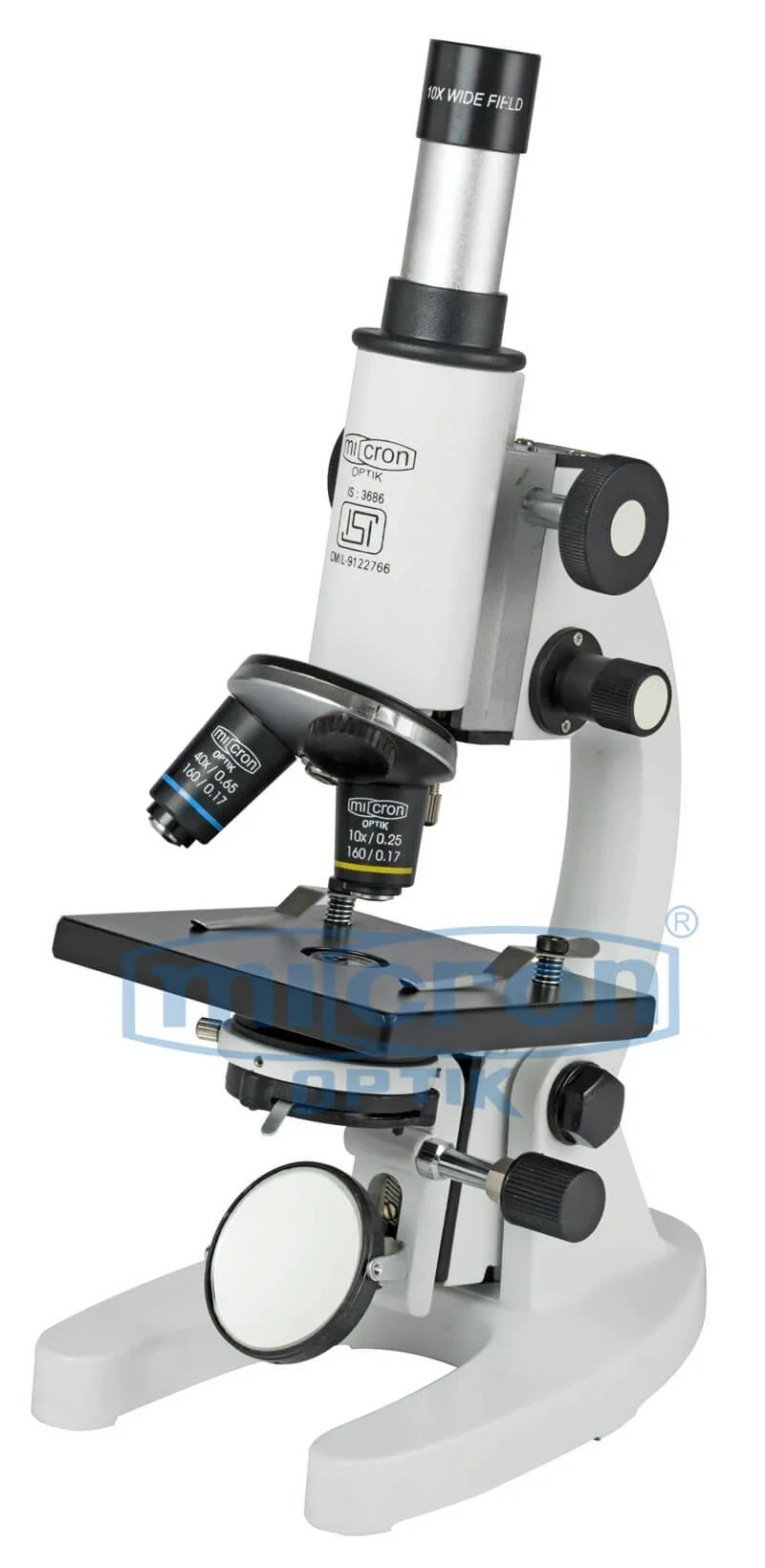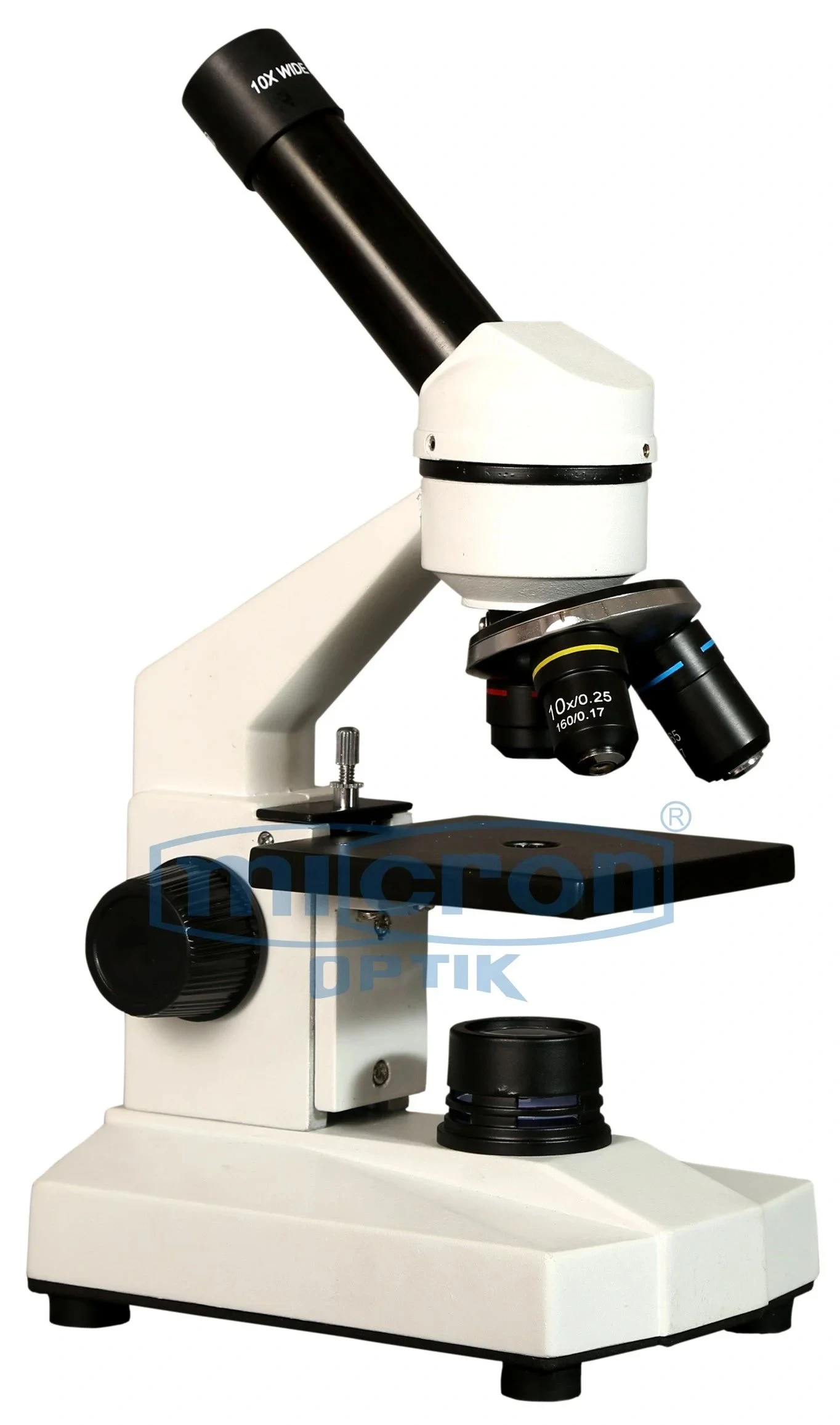
1.Sturdy and well balanced monocular body, inclined to horizontal level of 90 degree
2. Fixed square stage 110 mm x 110 mm
3. Dust proof triple revolving nose piece with positive click stops
4. Focusing by coarse and fine adjustment without scale
5. Focuable through Rack and Pinion Substage Abbe type N.A. 1.25 condenser with iris diaphragm
6. Illumination by plano concave mirror in fork mount.
7. Steple Grey, chemical resistant, back-on finish.
8. With dust cover dully packed in styofoam case.
EYE PIECES: 10X & 15X [Huygenian]
OBJECTIVES: 10X & 40X S/L [Achromatic]
MAGNIFICATION: X100 – X600
1. Illumination by sub stage pin type lamp working on 220 volts – 15 watt. Model : ML-1.
2. Mechanical stage for X – Y movements of slide.
3. Eye Pieces: W.F. 10X.
4. Objectives: X4, X20, X45 S/L, X60 S/L, X100 S/L Oil.
Microscope for high school students will always be designed with 40x, 100x and 400x magnification. A microscope designed for a high school student have a monocular body, are equipped with dust proof triple revolving nose piece and are illuminated by a Plano concave mirror in fork mount.
The best microscopes for high school students are compact and lightweight in design and provides digital imaging. Such microscopes designed for high school students are designed to study macro-sized specimens. Exceptionally sturdy and easy to use, this model is ideal for senior educational purposes in the classroom, especially designed for school and medical students, eliminating many of the needless complexities of conventional instruments, yet has every essential feature for microscopic studies.
Micron's KG-3 model is a step up in complexity and capability, designed to meet the rigorous demands of senior high school and introductory college biology courses. The sturdy, well-balanced monocular body is inclined to a 90-degree horizontal level, promoting a comfortable posture for extended use. This model is frequently cited as one of the best microscopes for advanced students who are serious about pursuing science in higher education. The fixed square stage is larger than entry-level models, accommodating a wider range of slide types. The dust-proof triple revolving nosepiece features positive click stops, ensuring that objectives are perfectly centered for a clear view. A significant upgrade is the inclusion of separate coarse and fine adjustment knobs, allowing students to achieve critical focus on fine specimen details. Micron has equipped this model with a substage Abbe type N.A. 1.25 condenser with an iris diaphragm, a feature usually found on professional instruments. For high schools seeking a top rated microscope for their advanced placement biology classes, the KG-3 is an exceptional choice. The illumination is provided by a plano concave mirror in a fork mount, teaching students the fundamentals of light management.
The optical combination of the KG-3 is designed to reveal the finest details. The 10X and 15X Huygenian eyepieces, combined with 10X and 40X S/L achromatic objectives, provide a magnification range of 100X to 600X. This powerful range makes it one of the best instruments for studying histology, cytology, and microbiology. The rack and pinion substage allows for precise control of the Abbe condenser, optimizing contrast and resolution. The chemical-resistant, stipple grey finish ensures the microscope remains in good condition despite frequent handling. Micron has also included a dust cover and styrofoam packing for safe storage. The optional accessories, such as the sub stage pin type lamp (Model ML-1) and the mechanical stage for X-Y movements, allow schools to upgrade the instrument for more advanced work. This model is a top rated workhorse for any educational laboratory preparing students for college-level science. The KG-3 successfully bridges the gap between a simple student microscope and a professional research instrument, providing essential features without unnecessary complexity.
Sturdy Monocular Body: The well-balanced, 90-degree inclined monocular body is designed for comfortable, prolonged use in classroom settings, reducing neck and back strain.
Abbe Condenser with Iris Diaphragm: The substage Abbe type N.A. 1.25 condenser with iris diaphragm allows advanced students to control contrast and resolution for professional-quality images.
Separate Coarse and Fine Focus: Dual focusing knobs (coarse and fine) provide precise control, enabling students to achieve critical focus on fine cellular and tissue details.
Dust-Proof Triple Nosepiece: The revolving nosepiece is dust-proof with positive click stops, protecting objectives and ensuring precise alignment for consistent viewing.
Wide Magnification Range (100X-600X): Supplied with 10X and 15X eyepieces and 10X and 40X S/L objectives, offering a magnification range suitable for advanced histology and cytology studies.
Rack and Pinion Substage: The substage is focusable via a rack and pinion mechanism, allowing for optimal positioning of the Abbe condenser to match the objective in use.
Chemical-Resistant Finish: The stipple grey, chemical-resistant finish protects the cast iron body from stains and corrosion, ensuring durability in a busy lab environment.
Optional Mechanical Stage: An optional mechanical stage with X-Y movements and vernier scales allows for precise slide positioning and tracking of specific specimen areas.
Senior High School Biology (AP/IB): Ideal for advanced placement and international baccalaureate courses requiring detailed observation of cell structures, mitosis, and tissue samples.
Introductory College Biology Labs: A reliable and capable instrument for first-year university students conducting lab work in general biology, botany, and zoology.
Pre-Medical and Pre-Dental Training: Suitable for students in pre-professional programs who need to learn basic histological techniques and microscopic anatomy.
Histology and Cytology Studies: The Abbe condenser and fine focus mechanism make it excellent for examining stained tissue sections and individual cell smears.
Microbiology Courses: Can be used to observe bacteria, protozoa, and fungi in stained preparations, especially with the optional 100X oil immersion objective.
Medical School Preparation: Helps students develop the manual dexterity and observational skills required for later professional studies in medicine or pathology.
Research Projects for Science Fairs: Its advanced features make it a capable tool for ambitious student-led research projects requiring high-quality microscopy.