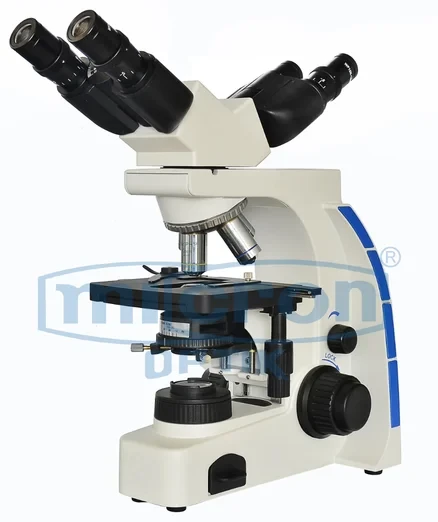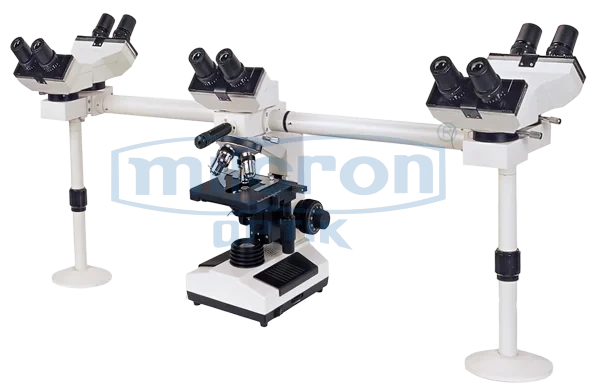
1. Single Mould Rigid Structure with a Window in Arm for easy Carriage
2. Viewing tube: As per Requirement
3. Head Sliding Type 45 Degree Inclined and Rotatable at 360 degree.
4. Quadruple Ball Bearing nose piece with positive click stops.
5. Co-axial Coarse & Fine focusing Graduated to 1Div=.002mm.
6. With Ball Bearing Driven Mechanical stage for X&Y movement of slide.
7. Movable abbe Condensor N.A.1.25 with iris diaphragm with swingout filter holder.
8. Built in Illumination LED with intensity control.
9. Steple Grey, chemical resistant, back-on finish.
10. Complete with Instruction Manual and dust cover.
11. Duly packed in styrofom packing.
EYE PIECES: WF 10X/18mm
OBJECTIVES: 4X, 10X, 40X S/L, 100X S/L [Achromatic]
MAGNIFICATION: X40 – X1000
1. Wooden Carrying Case
2. Objectives: X20, X45 S/L, X60 S/L
Micron Optiks is a deca head microscope manufacturer and supplier offering a range of 10 headed multi viewing microscope which is an appropriate choice for teaching and on the job training.
The dual head microscope offers it user an effective color accuracy across the sample with improved contrasting and vivid images. The multi-head microscope can depict all the images in a similar manner thereby minimizing the scope of errors. These microscopes have built-in high eyepoints to provide better clarity of the specimen.
Micron's Dual Head Microscope is a specialized teaching and collaboration tool that allows two users to view the same specimen simultaneously. It is built on the robust single mould rigid structure of the Cresta series, featuring a window in the arm for easy carriage. This model is widely considered one of the best dual head microscopes for medical training, quality control, and collaborative research. The viewing head consists of a primary binocular head and a secondary binocular head, both of the sliding type, 45 degrees inclined, and rotatable 360 degrees. This configuration allows two users to sit opposite each other and share the view. Micron has equipped this microscope with a quadruple ball-bearing nosepiece with positive click stops and a co-axial coarse and fine focusing mechanism graduated to 0.002mm. For educational institutions seeking a top rated teaching microscope for small group instruction, the Dual Head Microscope is an invaluable tool. The ball-bearing driven mechanical stage and movable Abbe condenser N.A. 1.25 provide the same high-end performance as Micron's research-grade instruments.
The built-in LED illumination with intensity control ensures a bright, stable light source for both viewers. The optical combination includes WF 10X/18mm eyepieces on both heads and 4X, 10X, 40X S/L, and 100X S/L achromatic objectives, providing a magnification range of 40X to 1000X. This shared viewing capability makes it one of the best solutions for training new technicians, as the trainer can guide the trainee in real-time. The dual head design eliminates the need for a separate teaching camera or monitor for simple collaborative tasks. Micron has finished the microscope in a durable, chemical-resistant stipple grey. This model is a top rated choice for any environment where two people need to see the same image simultaneously, from medical schools to industrial quality assurance labs.
Simultaneous Dual-User Viewing: Two binocular viewing heads allow two people (e.g., an instructor and a student) to view the exact same specimen at the same time, facilitating real-time teaching and collaboration.
Independent Rotatable Heads: Both viewing heads are of the sliding type, 45-degree inclined, and independently rotatable 360 degrees, allowing two users to sit comfortably opposite each other.
Single Mould Rigid Structure: The microscope is built on Micron's robust, single mould cast iron frame with a carriage window, providing stability and easy transport between labs or classrooms.
Co-Axial Precision Focusing: The co-axial coarse and fine focusing mechanism provides ultra-precise control (0.002mm divisions), ensuring sharp images for both viewers.
Shared High-Quality Optics: Both users view through the same set of high-quality achromatic objectives (4X, 10X, 40X, 100X), ensuring both see the same field of view and details.
Ball-Bearing Mechanical Stage: The low-positioned, ball-bearing driven mechanical stage allows the primary user (or instructor) to navigate the slide smoothly and precisely for both viewers.
Variable Intensity LED Illumination: The built-in 3W LED light with intensity control provides a bright, cool, and stable light source that is sufficient for clear viewing through both heads.
Movable Abbe Condenser: The N.A. 1.25 Abbe condenser is focusable and includes an iris diaphragm, allowing the user to optimize contrast for clear viewing by both parties.
Medical and Veterinary Training: Ideal for teaching histology, pathology, and clinical microscopy, allowing an instructor to guide a student in real-time on identifying specific cells or structures.
Quality Control in Manufacturing: Enables a supervisor and a technician to collaboratively inspect components, discuss defects, and make pass/fail decisions together without switching positions.
Clinical Consultation and Second Opinions: Allows two pathologists or clinicians to sit together and review a challenging case, facilitating immediate discussion and diagnosis.
Research Collaboration: Permits two researchers to observe the same experiment or specimen simultaneously, fostering direct communication and collaborative analysis.
Forensic Laboratory Work: Ideal for a senior examiner to train a junior examiner on trace evidence analysis, such as comparing hair or fiber samples side-by-side in real-time.
Art Conservation and Authentication: Allows two conservators or art historians to simultaneously examine the microstructure of a painting or artifact for analysis or authentication.
Educational Outreach and Public Events: Perfect for museum exhibits, science fairs, or open houses, allowing two visitors to view a specimen at the same time, enhancing the shared learning experience.