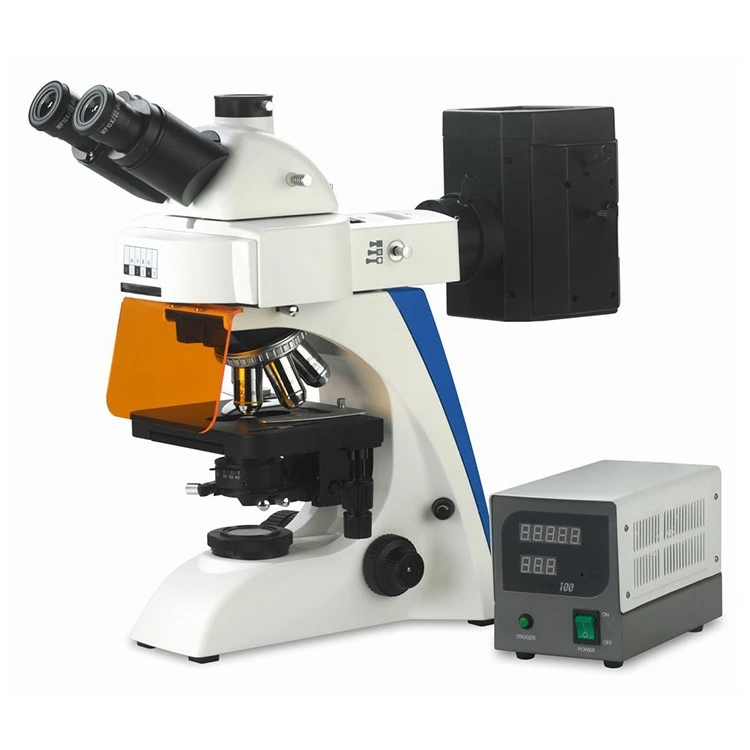
With Basic Features same as of Model: Cresta ZS 50i
Fluoroscence Specifications:
Mercury lamp House: 100W/DC
Fluorescence Filter System
Blue Wavelength 450~490nm
Green Wavelength 495~555nm
Complete Fluorescence and Base Microscope Specifications: Base Microscope: Cresta ZS 50i (inverted). Features: Single mould rigid structure, Siedentopf type trinocular head (30-degree inclined, 360-degree rotatable), reversed inward quadruple ball-bearing nosepiece, co-axial coarse and fine focusing (0.002mm divisions), ball-bearing mechanical stage, movable Abbe condenser N.A. 1.25, built-in transmitted LED illumination. Fluorescence Module: 100W DC mercury lamp house with power supply. Fluorescence Filter System: Blue filter set (Excitation 450-490nm, Dichroic Mirror 510nm, Emission Barrier 520nm) for FITC, Alexa Fluor 488. Green filter set (Excitation 480-550nm, Dichroic Mirror 570nm, Emission Barrier 590nm) for TRITC, Cy3, Texas Red. The filter sets are housed in a slider or revolving turret. UV protection barrier is included. The trinocular head splits light for camera and eyepieces. The system is compatible with a wide range of C-mount cameras.
A fluorescent microscope is a type of an Optikal microscope which uses fluorescence technology to generate precise images of organic and inorganic substances. The basic principle behind the working of such microscopes is the emission of light within specific wavelengths which produce high power LED images. As a fluorescent microscope manufacturer, we ensure that our products are designed in a manner that allow the scholars to study the complex and dynamic processes in living cells with extraordinary accuracy.
The Cresta ZS 50i FL from Micron is a powerful epi-fluorescence microscope built on the robust and ergonomic Cresta ZS 50i platform. It shares the same basic features as the standard Cresta ZS 50i, including a single mould rigid structure, a Siedentopf type trinocular head, a reversed inward quadruple nosepiece, and co-axial focusing. This model is widely regarded as one of the best entry-to-mid-level fluorescence microscopes for laboratories needing to perform routine fluorescence work.
The key differentiator is the addition of a 100W DC mercury lamp house for reflected light fluorescence. This powerful light source, combined with a high-quality fluorescence filter system, enables researchers to visualize fluorescently labeled specimens with high contrast and sensitivity. Micron has designed this system to be both powerful and user-friendly. For research and clinical labs seeking a top rated fluorescence microscope for applications like FITC and TRITC imaging, the Cresta ZS 50i FL is an exceptional value. The system includes a blue filter set (excitation 450-490nm) for FITC and a green filter set (excitation 480-550nm) for TRITC or similar fluorophores.
The inverted optical design (implied by the ZS 50i base) is particularly well-suited for live-cell fluorescence imaging, as it allows for observation of cells in culture vessels. The trinocular head is essential for capturing high-quality fluorescence images with a digital camera. This capability makes it one of the best tools for documenting dynamic cellular processes and for publication-quality imaging. The protection barrier to resist ultraviolet light is a critical safety feature for the operator. Micron has ensured that the brightfield and phase contrast capabilities of the base microscope are fully retained, making the Cresta ZS 50i FL a highly versatile instrument. This model is a top rated choice for life science research, clinical diagnostics, and educational laboratories that require the power of fluorescence microscopy.
100W Mercury Lamp Fluorescence: Equipped with a powerful 100W DC mercury lamp house, providing the intense, broad-spectrum light required for high-sensitivity fluorescence imaging.
Dual Fluorescence Filter Sets: Includes blue (450-490nm excitation) and green (480-550nm excitation) filter sets, enabling detection of common fluorophores like FITC, Alexa Fluor 488, TRITC, and Cy3.
Robust Cresta ZS 50i Platform: Built on Micron's high-quality Cresta ZS 50i inverted frame, offering a single mould rigid structure, ergonomic Siedentopf head, and precision co-axial focusing.
Trinocular Head for Imaging: The trinocular viewing head is essential for attaching a digital camera, allowing users to capture high-quality fluorescence micrographs for documentation and publication.
UV Protection Barrier: A built-in protection barrier resists harmful ultraviolet light from the mercury lamp, ensuring operator safety during fluorescence observation.
Inverted Optical Design: The inverted design allows for the observation of living cells in culture flasks and petri dishes, making it ideal for live-cell fluorescence applications.
Co-Axial Precision Focusing: The co-axial coarse and fine focusing mechanism with 0.002mm divisions allows for precise focusing on thin optical sections in fluorescence mode.
Versatile Multi-Mode Capability: Retains full brightfield and phase contrast capabilities of the base microscope, making it a versatile tool for a wide range of biological applications.
Immunofluorescence and Immunocytochemistry: Ideal for visualizing the location and expression of specific proteins within fixed cells and tissues using fluorescently labeled antibodies.
Live-Cell Imaging and Dynamics: Perfect for observing dynamic cellular processes such as apoptosis, cell division, and organelle movement in living cells using fluorescent protein tags like GFP.
FISH (Fluorescence In Situ Hybridization): Can be used to detect and localize specific DNA or RNA sequences on chromosomes or in tissue sections.
Apoptosis and Cell Viability Assays: Suitable for performing fluorescence-based assays to study programmed cell death, cell health, and toxicity in response to various treatments.
Calcium and pH Imaging: Capable of imaging fluorescent ion indicators (e.g., Fura-2, Fluo-4) to measure intracellular calcium concentrations or pH changes in living cells.
Neuroscience and Developmental Biology: Used for imaging neuronal structures, tracking neural development, and studying gene expression patterns in model organisms.
Clinical Pathology and Diagnostic Labs: Can be used for diagnostic applications such as detecting autoantibodies in autoimmune diseases (e.g., ANA test) or identifying pathogens using fluorescent probes.