 BIOLOGICAL MICROSCOPES
 Histopathology & Clean Room Equipments
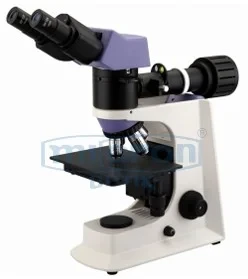
A Metallurgical Microscope is specifically designed for the inspection of polished metal samples, ceramics, and coatings. Unlike biological scopes, they use reflected light (epi-illumination) because metals are opaque and do not transmit light. Micron's metallurgical microscopes are widely considered the best for heat treatment verification and failure analysis.
The light source passes through the objective lens, reflects off the surface of the metal, and returns through the objective to the eyepiece. This design ensures that the entire light path is optimized for the highest resolution of surface details. Rated as top rated equipment for automotive parts manufacturing, they detect surface cracks and porosity. The objectives are specifically corrected for the flat field requirements of capturing large metal grains in a single frame.
Micron metallurgical scopes feature a large, heavy-duty mechanical stage that can support heavy samples like engine blocks or welded joints. The stage moves smoothly via coaxial controls, allowing the operator to scan systematically across the sample. For measuring case depth in hardened steel, this precise scanning is the best feature. The built-in polarizer and analyzer are essential for identifying non-metallic inclusions (like sulfides and oxides) in steel, which glow brightly under polarized light.
These microscopes are crucial for quality control in industries like aerospace, automotive, and electronics manufacturing. They are used to verify microstructure, measure grain size (ASTM standards), and inspect plating thickness. That is why Micron is a top rated provider for NABL-accredited testing labs. The trinocular port allows for attaching high-resolution cameras to capture micrographs for certification reports.
Investing in a Micron Metallurgical Microscope ensures the structural integrity of your materials. It is the best choice for any facility involved in metal processing, welding, or heat treating. By revealing the hidden microstructure, it helps predict the mechanical performance and lifespan of critical components.

 SURGICAL MICROSCOPES