
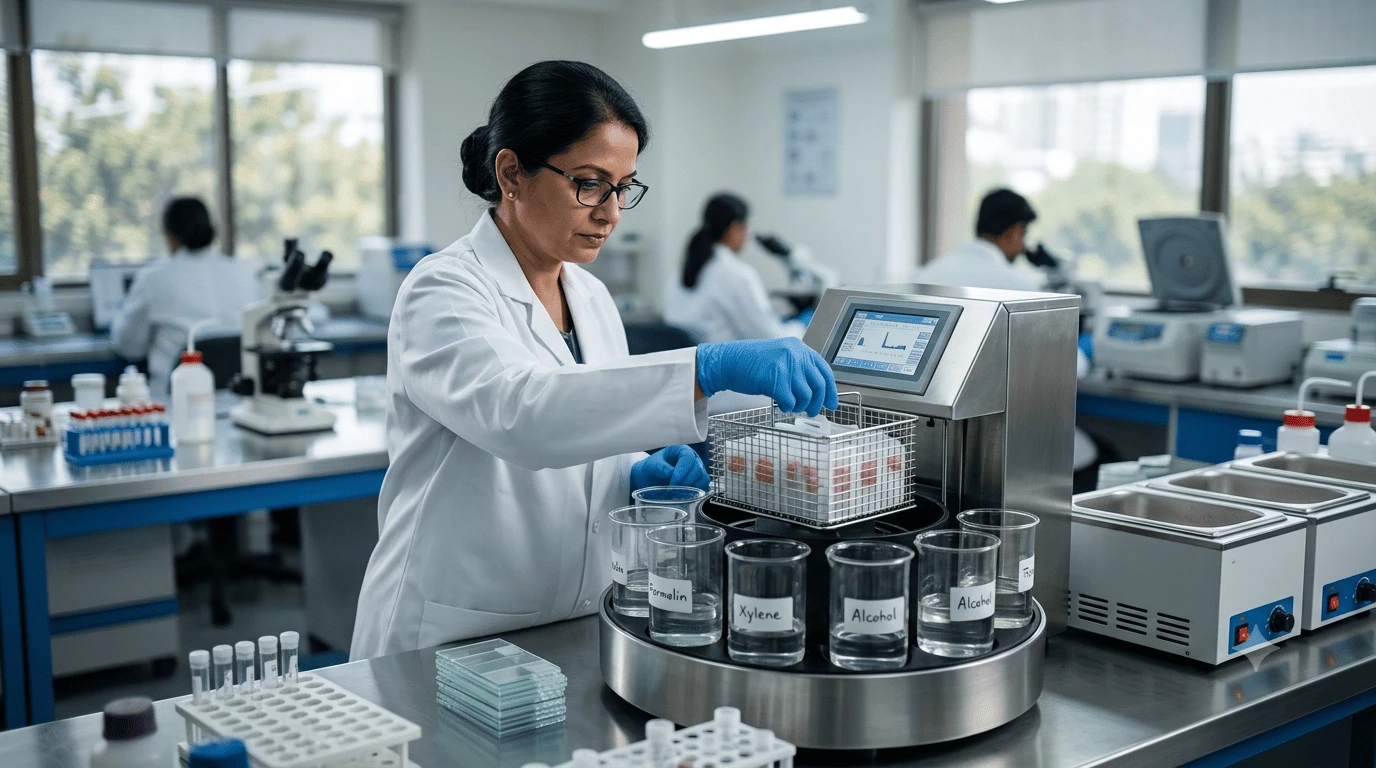
In modern diagnostic histopathology, clinical oncology, and histological research, specimen integrity directly governs diagnostic precision. Central to achieving flawless sample preparation is the vacuum tissue processor—an advanced, enclosed laboratory instrument designed to automate sample fixation, dehydration, clearing, and paraffin infiltration under controlled vacuum and pressure.
Whether you are looking to buy a vacuum tissue processor, upgrade from a traditional carousel unit, or equip a tertiary care hospital laboratory, selecting the right manufacturer and model is a strategic decision.
This comprehensive guide explores why laboratories choose vacuum tissue processing technology, highlights key global and Indian manufacturers, compares specifications, and provides essential buying guidelines to maximize return on investment (ROI).
A vacuum tissue processor (also known as an enclosed tissue processor, closed-system tissue processor, or automated vacuum tissue processing unit) is an advanced histopathology instrument where tissue specimens remain stationary inside a sealed, temperature-regulated reaction chamber (retort).
Unlike open carousel systems that transport tissue baskets through exposed reagent beakers, vacuum tissue processors pump chemical reagents, clearing solvents, and molten paraffin wax directly into the sealed chamber under precise micro-vacuum assistance.
Enclosed Vacuum Tissue Processing Cycle ┌───────────────────────┐ │ Sealed Retort Chamber │ ◄── Reagents & Wax Pumped In/Out Automatically └───────────┬───────────┘ │ ── Vacuum Assistance Applied ▼ 1. Fixation (Formalin + Vacuum) 2. Dehydration (Graded Alcohols + Vacuum) 3. Clearing (Xylene / Solvent + Vacuum) 4. Paraffin Infiltration (Molten Wax + Vacuum & Pressure)When evaluating whether to buy a vacuum tissue processor over a traditional open carousel system, healthcare procurement officers and laboratory directors benefit from significant operational advantages:
Vacuum pressure eliminates micro-air pockets trapped within biological tissues and speeds up fluid penetration. This accelerates dehydration and paraffin wax exchange, reducing cycle times by up to 30–50% compared to ambient pressure processing.
Open xylene and formalin vapors pose health hazards to laboratory technicians. Enclosed vacuum systems feature built-in chemical fume extraction, activated carbon filters, and closed-loop liquid transfer, preventing toxic fumes from escaping into the lab environment.
High-end vacuum tissue processors monitor fluid levels, temperature limits, and pressure differentials continuously. In the event of a power grid failure or reagent blockage, automated safety overrides protect precious biopsy specimens from drying out or scorching.
While carousel units typically handle 100 to 150 cassettes, closed vacuum processors offer expanded retort capacities designed for 200 to 400+ cassettes per run, catering to high-volume diagnostic reference centers.
When looking to purchase top-tier, high-capacity vacuum tissue processors with advanced automation, several global manufacturers dominate the industry:
Leica Biosystems is an industry leader in histopathology equipment. Popular models include the HistoCore PELORIS 3 and HistoCore PEGASUS.
· Key Features: Dual-retort design allows continuous, parallel processing of urgent biopsies and standard runs simultaneously.
· Best For: High-volume reference laboratories, central oncology hubs, and academic medical centers.
Sakura Finetek is world-renowned for rapid tissue processing technology. Key models include the Tissue-Tek VIP 6 AI and Tissue-Tek Xpress.
· Key Features: Automated reagent management systems, self-cleaning retorts, color-coded bottle management, and smart safety tracking.
· Best For: Tertiary clinical hospitals and fast-turnaround pathology chains.
Milestone Scientific pioneered microwave-assisted and hybrid tissue processing technology. Popular models include LOGOS and Pathos Delta.
· Key Features: Combined microwave and vacuum processing enables same-day diagnostic results while significantly reducing xylene consumption.
· Best For: Eco-conscious laboratories seeking ultra-rapid biopsy turnarounds.
Thermo Fisher offers enclosed vacuum tissue processors such as the Excelsior AS and STP 420ES.
· Key Features: Circular chamber design for uniform temperature distribution, automated reagent rotation algorithms, and intuitive touchscreen control.
· Best For: Clinical histology centers seeking robust performance and user-friendly operation.
SLEE Medical produces precision German-engineered histology instruments, including benchtop vacuum processors.
· Key Features: High-durability stainless steel reaction chambers, precise temperature control interlocks, and compact footprints.
· Best For: Medium-to-large clinical pathology departments.
Before issuing a purchase order to buy a vacuum tissue processor, evaluate candidate machines against this technical specification checklist:
Feature / Module | Target Standard Specification | Why It Matters |
Control Unit | Microprocessor with color LCD touchscreen and delay start (0–99 hours) | Allows multi-protocol programming, custom runs, and overnight processing. |
Retort Capacity | 150 to 300+ tissue cassette capacity per run | Ensures the unit meets daily diagnostic specimen load requirements. |
Vacuum & Pressure Range | Controlled vacuum (-20 to -70 kPa) & pressure (+20 to +50 kPa) | Optimizes reagent infiltration into dense tissue blocks. |
Temperature Control | Wax bath and retort heating ($45^\circ\text{C} \text{ to } 65^\circ\text{C} \pm 1^\circ\text{C}$) | Maintains uniform paraffin wax viscosity without thermal tissue damage. |
Reagent Management | Automated reagent transfer & bottle rotation algorithms | Reduces manual reagent handling and extends solvent shelf life. |
Safety & Fume Control | Activated carbon filters + integrated UPS battery backup | Protects staff from chemical vapors and guards specimens during power cuts. |
The cost of a vacuum tissue processor varies depending on capacity, automation levels, brand origin, and safety features:
· Domestic Indian Vacuum Tissue Processors (Ambala / Delhi): ₹4,50,000 to ₹12,00,000 ($5,400 – $14,000 USD approx.)
o Features: 150–200 cassette capacity, stainless steel retort, microprocessor controls, built-in vacuum pump.
· Imported High-End Closed Vacuum Systems (Global Brands): ₹15,00,000 to ₹45,00,000+ ($18,000 – $55,000+ USD approx.)
o Features: Dual-retort continuous processing, automated reagent density checking, touchscreen GUI, microwave assistance.
To ensure a smooth purchase and reliable long-term performance:
1. Verify International Certifications: Confirm that the manufacturer holds ISO 9001:2015, ISO 13485 (medical device quality management), and CE certifications.
2. Request On-Site Demonstrations: Ask the supplier or local distributor for a live demonstration or clinical references from existing hospital clients.
3. Evaluate Warranty and AMC Terms: Insist on a minimum 12-to-24-month comprehensive warranty, backed by affordable Annual Maintenance Contracts (AMC) and certified local service engineers.
4. Confirm Spare Parts & Reagent Compatibility: Ensure that replacement valves, gaskets, filters, and standard lab reagents are readily accessible in your local market.
Deciding to buy a vacuum tissue processor is one of the most impactful upgrades a pathology laboratory can make. By providing accelerated infiltration, enhanced fume safety, automated fluid management, and robust sample protection, enclosed vacuum processors set the standard for modern histopathology workflows.
Whether you choose global leaders like Leica, Sakura, or Thermo Fisher for high-volume dual-retort processing, or partner with certified domestic Indian manufacturers like Micro Teknik, Atico India, or Almicro Instruments for high-value reliability, evaluating your lab's volume and technical needs will ensure a successful procurement.