
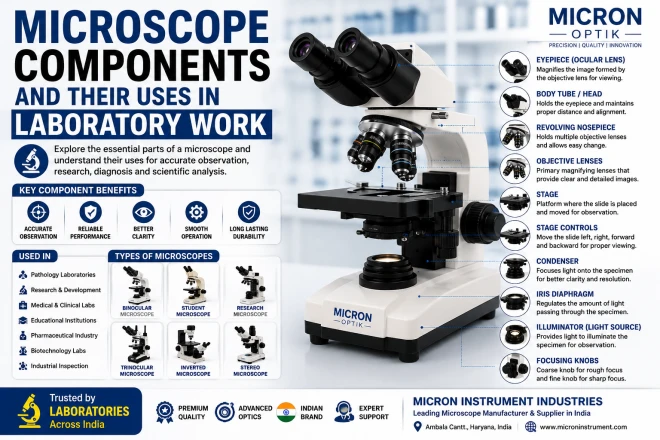
Microscopes are among the most important scientific instruments used in educational institutions, pathology laboratories, medical colleges, biotechnology centers, pharmaceutical industries, and research facilities. They allow scientists, students, researchers, and laboratory technicians to observe microscopic structures with clarity and precision.
Understanding microscope components and their uses is essential for accurate laboratory observation and scientific analysis. Every part of a microscope plays an important role in magnification, illumination, specimen positioning, and image clarity.
Modern laboratory microscope systems manufactured by leading microscope manufacturers in india are designed with advanced optical technology, ergonomic controls, precision mechanics, and LED illumination for educational and research applications. Companies like micron instrument industries and micron optik microscope systems continue supplying advanced microscope solutions for laboratories across India.
Importance of Microscope Components in Laboratory Work
Each microscope component contributes to the overall performance of the microscope. Proper understanding of these components helps users:
Operate microscopes correctly
Improve observation accuracy
Prevent specimen damage
Achieve better image clarity
Perform scientific analysis efficiently
Modern laboratories searching for microscope suppliers in india and microscope company in india solutions prefer microscopes that provide durability, smooth operation, and precision optics.
Eyepiece (Ocular Lens)
The eyepiece is the top lens through which the user views the specimen. Most microscopes use 10x eyepieces that work together with objective lenses to magnify the image.
Modern binocular microscope systems include dual eyepieces for comfortable long-duration observation in pathology and research laboratories.
Objective Lenses
Objective lenses are the primary magnifying lenses mounted near the specimen stage. Different objective lenses provide different levels of magnification such as:
4x
10x
40x
100x oil immersion
These lenses are extremely important in research microscope systems where high-resolution observation is required.
Revolving Nosepiece
The revolving nosepiece holds the objective lenses and allows smooth switching between different magnification levels.
Professional microscope systems manufactured by best microscope manufacturers in ambala now include precision revolving mechanisms for smoother operation.
Stage and Stage Controls
The stage is the flat platform where the microscope slide is placed for observation.
Mechanical stage controls help:
Move the slide smoothly
Position the specimen accurately
Scan different areas of the specimen
Improve observation efficiency
Modern student microscope and laboratory microscope systems include smooth mechanical stage movement for easier specimen handling.
Condenser
The condenser focuses light onto the specimen to improve brightness and image clarity.
Proper condenser adjustment improves:
Illumination
Image contrast
Resolution
Observation accuracy
Leading top microscope brands in india now provide advanced condenser systems designed for precise laboratory observation.
Iris Diaphragm
The iris diaphragm regulates the amount of light passing through the specimen.
This component helps:
Control brightness
Improve image contrast
Reduce glare
Enhance visibility
Modern microscopes manufactured by educational microscope manufacturer companies include smooth iris diaphragm adjustment systems.
Illuminator (Light Source)
Modern microscopes use LED illumination systems that provide bright, energy-efficient, and uniform lighting for laboratory applications.
LED illumination offers:
Better visibility
Lower power consumption
Long operational life
Reduced maintenance
Many laboratories searching for best microscope in india prefer microscopes with advanced LED lighting systems.
Coarse and Fine Focus Knobs
The coarse focus knob is used for rapid initial focusing, while the fine focus knob provides precise image sharpening.
These focus controls are extremely important for:
Accurate specimen observation
High magnification viewing
Research applications
Pathology analysis
Modern microscope manufacturers now design ergonomic focusing systems for smoother and more accurate operation.
Types of Microscopes Used in Laboratories
Different laboratories use different microscope systems depending on their applications.
Binocular Microscope
A binocular microscope is commonly used in pathology laboratories and educational institutions for comfortable viewing.
Research Microscope
A research microscope is designed for advanced scientific observation and microbiology studies.
Student Microscope
A student microscope is widely used in schools and colleges for biology practicals.
Inverted Microscopes
Inverted microscopes are used for tissue culture studies, IVF applications, and live cell observation.
Bino Microscope
A bino microscope provides dual-eye viewing and improved user comfort during laboratory work.
Applications of Laboratory Microscopes
Microscopes are widely used in:
Pathology laboratories
Medical colleges
Research institutes
Biotechnology laboratories
Pharmaceutical industries
Educational institutions
Industrial inspection units
Reliable microscope systems supplied by trusted microscope companies in india improve laboratory productivity and scientific accuracy.
Choosing the Best Microscope in India
When selecting a microscope, buyers should evaluate:
Optical quality
Mechanical durability
Focus smoothness
LED illumination
Service support
Warranty coverage
Trusted brands like micron optik microscope systems continue providing advanced microscope solutions for educational and scientific applications across India.
Conclusion
Understanding microscope components and their uses is essential for accurate laboratory work and scientific observation. Every microscope part contributes to image quality, specimen handling, and smooth operation.
Modern microscope systems manufactured by leading microscope manufacturer in india companies now provide precision optics, ergonomic controls, durable construction, and advanced illumination systems suitable for educational, clinical, and research applications.