
Histopathology Equipment, Histopathology Equipment Manufacturer, Histopathology Laboratory Equipment, Histopathology Instruments, Histopathology Lab Setup, Microtome Manufacturer in India, Rotary Microtome, Tissue Processor, Tissue Embedding Station, Tissue Floatation Bath, Slide Warmer, Grossing Station, Automatic Slide Stainer, Coverslipper, Laboratory Equipment Manufacturer, Pathology Lab Equipment, Histology Equipment, Medical Laboratory Equipment, Micron Optik, Micron Instrument Industries.
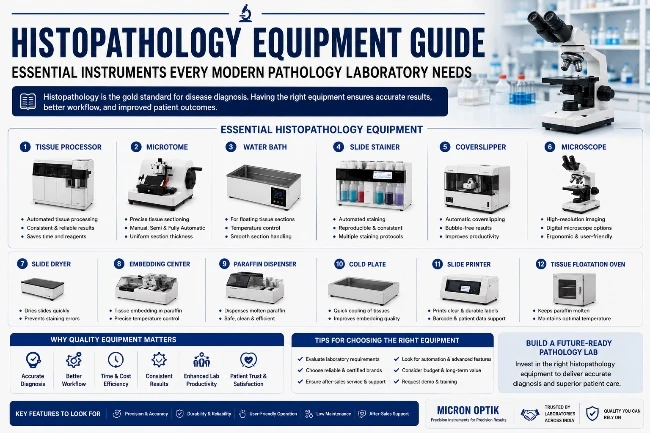
Histopathology Equipment Guide: Essential Instruments Every Modern Pathology Laboratory Needs
Histopathology is one of the most important branches of diagnostic medicine. It enables pathologists to examine tissue samples under a microscope, helping doctors diagnose diseases such as cancer, infections, inflammatory conditions, and many other disorders. The quality of diagnosis depends not only on the expertise of the pathologist but also on the quality of the histopathology equipment used throughout the laboratory workflow.
Whether you are establishing a new pathology laboratory, expanding a hospital laboratory, or upgrading equipment in a medical college, selecting the right instruments is essential for improving efficiency, accuracy, and laboratory productivity.
This guide explains the major equipment used in a histopathology laboratory and what you should consider before investing in them.
What is Histopathology?
Histopathology is the microscopic examination of tissue specimens to identify abnormalities and diagnose diseases. Tissue samples collected during surgery or biopsy undergo several processing stages before they are examined under a microscope.
Each stage requires specialized laboratory equipment that works together to ensure accurate diagnostic results.
Essential Histopathology Equipment
A complete histopathology laboratory consists of several precision instruments, each designed for a specific step in tissue preparation.
1. Grossing Station
The grossing station is the first workstation where tissue specimens are examined, measured, trimmed, and prepared before processing.
A modern grossing station typically includes:
Stainless steel work surface
Exhaust ventilation system
LED illumination
Water tap and sink
Formalin collection system
Magnifying glass
Instrument storage
Proper ventilation protects laboratory personnel from formalin fumes while improving working conditions.
2. Tissue Processor
A tissue processor prepares tissue samples by removing water and replacing it with paraffin wax through a sequence of dehydration, clearing, and infiltration.
Modern automatic tissue processors offer:
Multiple programmable cycles
Vacuum processing
Paraffin heating
Automatic reagent transfer
User-friendly touchscreen controls
Overnight processing
Reliable tissue processing is critical for producing high-quality tissue sections.
3. Tissue Embedding Station
After processing, tissues are embedded in paraffin blocks using an embedding station.
A quality embedding centre provides:
Heated paraffin dispenser
Heated working area
Cold plate
Forceps warmer
Temperature control
Ergonomic design
Proper embedding ensures accurate orientation of tissue before sectioning.
4. Rotary Microtome
The rotary microtome is considered the heart of every histopathology laboratory. It cuts ultra-thin tissue sections, typically between 2 and 5 microns, for microscopic examination.
Modern rotary microtomes include:
Precision specimen feed
Disposable blade holder
Section thickness adjustment
Handwheel safety lock
Specimen retraction
Universal cassette clamp
Laboratories can choose from manual, semi-automatic, or fully automatic rotary microtomes depending on workload.
5. Tissue Floatation Bath
Freshly cut tissue ribbons are transferred onto warm water in a tissue floatation bath to remove wrinkles before mounting onto microscope slides.
Important features include:
Uniform temperature control
Corrosion-resistant tray
Digital display
Easy cleaning
Stable heating system
Proper floatation improves section quality and staining results.
6. Slide Warmer
After mounting tissue sections onto glass slides, a slide warmer gently dries them before staining.
A quality slide warmer provides:
Uniform heating
Digital temperature control
Energy-efficient operation
Quick heating
Consistent drying
This step helps tissue sections adhere firmly to the slides.
7. Automatic Slide Stainer
Automatic slide stainers simplify the staining process by automating routine protocols such as Hematoxylin and Eosin (H&E) staining.
Benefits include:
Consistent staining quality
Reduced technician workload
Higher throughput
Programmable staining cycles
Reduced human error
Automation improves laboratory efficiency while maintaining reproducibility.
8. Automatic Coverslipper
After staining, tissue sections require a coverslip for permanent preservation and microscopic examination.
Automatic coverslippers provide:
Bubble-free mounting
Uniform adhesive application
High productivity
Reduced manual handling
They improve workflow in high-volume pathology laboratories.
9. Laboratory Microscope
The final diagnostic step involves examining stained tissue sections under a microscope.
Pathology laboratories generally use:
Binocular Microscopes
Trinocular Microscopes
Digital Microscopes
Research Microscopes
High-quality optics are essential for accurate diagnosis.
How to Select Histopathology Equipment
When investing in laboratory equipment, consider the following factors:
Laboratory Workload
High-volume laboratories require automated systems, while smaller laboratories may benefit from manual or semi-automatic instruments.
Build Quality
Choose equipment manufactured using durable materials that ensure long service life and consistent performance.
Ease of Operation
Modern touchscreen interfaces reduce operator training time and improve productivity.
Safety Features
Equipment should include appropriate safety mechanisms to protect laboratory personnel.
Service Support
Reliable after-sales service, spare parts availability, installation, and training are essential for uninterrupted laboratory operations.
Why Choose an Indian Manufacturer?
Indian manufacturers have made remarkable progress in precision laboratory equipment and now offer products that meet international quality standards.
Advantages include:
Faster delivery
Local technical support
Readily available spare parts
Competitive pricing
Easy GeM procurement
Better communication with manufacturers
Purchasing from an experienced Indian manufacturer also ensures quicker response times for installation and maintenance.
Why Choose Micron Optik?
For nearly six decades, Micron Optik, manufactured by Micron Instrument Industries, has been providing high-quality microscopes and histopathology laboratory equipment to hospitals, medical colleges, diagnostic centres, and research institutes across India.
Micron Optik offers a complete range of histopathology equipment, including:
Grossing Stations
Tissue Processors
Tissue Embedding Stations
Rotary Microtomes
Tissue Floatation Baths
Slide Warmers
Slide Stainers
Coverslippers
Laboratory Microscopes
Each product is designed with precision engineering, user-friendly operation, and long-term reliability in mind.
Conclusion
A well-equipped histopathology laboratory depends on the seamless integration of multiple precision instruments. From specimen grossing to microscopic examination, every stage of the workflow contributes to accurate diagnosis and efficient laboratory operation.
When selecting histopathology equipment, laboratories should focus not only on price but also on precision, durability, automation, service support, and manufacturer experience.
Choosing reliable equipment from an experienced manufacturer ensures consistent performance, improved workflow, and long-term value.
Whether you are establishing a new pathology laboratory or upgrading an existing facility, investing in high-quality histopathology equipment will enhance diagnostic accuracy and laboratory productivity for years to come.