
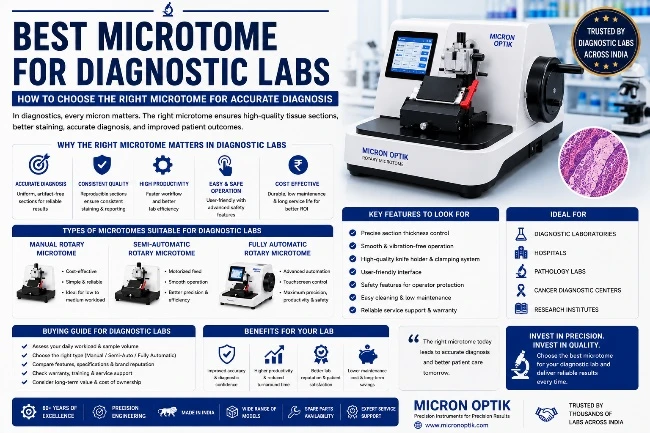
Diagnostic laboratories play a critical role in modern healthcare by providing accurate and timely pathology reports. Every day, thousands of biopsy and surgical tissue samples are processed to help diagnose cancer, infections, inflammatory diseases, and other medical conditions. At the heart of this process is one essential instrument—the rotary microtome.
Choosing the best microtome for diagnostic labs is not simply about selecting the most advanced or expensive model. The right microtome should deliver exceptional precision, smooth operation, high productivity, and long-term reliability. Since tissue section quality directly influences microscopic diagnosis, investing in a high-quality microtome is one of the most important decisions for any pathology laboratory.
This guide explains how to select the best microtome for a diagnostic laboratory and the key features that laboratories should consider before purchasing.
Why a Quality Microtome is Essential for Diagnostic Laboratories
Unlike teaching institutions, diagnostic laboratories work with patient samples every day. Every tissue section must be accurate because the final diagnosis depends on the quality of microscopic examination.
A precision-engineered microtome helps laboratories:
Produce wrinkle-free tissue sections
Improve staining quality
Reduce repeat sectioning
Increase technician productivity
Deliver faster pathology reports
Minimize equipment downtime
Reliable equipment ultimately improves patient care while reducing operational costs.
Types of Microtomes Suitable for Diagnostic Labs
Manual Rotary Microtome
Manual rotary microtomes remain an excellent option for laboratories processing a moderate number of tissue samples.
They are suitable for:
Independent pathology laboratories
Small diagnostic centres
Hospital pathology departments
Routine histopathology work
Advantages include:
Simple operation
Affordable investment
Low maintenance
Excellent durability
Semi-Automatic Rotary Microtome
Semi-automatic models offer improved productivity while maintaining operator control.
Ideal for:
Medium-sized diagnostic laboratories
Multi-speciality hospitals
Growing pathology centres
Benefits include:
Faster trimming
Reduced operator fatigue
Better workflow
Improved section consistency
Fully Automatic Rotary Microtome
Large diagnostic laboratories processing hundreds of tissue blocks every day benefit significantly from fully automatic systems.
Advantages include:
Motorized sectioning
Soft touch screen controls
Automatic trimming
Adjustable cutting speed
Digital section counter
Consistent section thickness
Higher daily productivity
These systems are particularly valuable for laboratories with high workloads.
Features to Look for Before Buying
Precision Section Thickness
The most important feature of any microtome is its ability to produce uniform tissue sections. Accurate section thickness improves staining quality and enables reliable microscopic examination.
Smooth Specimen Feed
A stable feed mechanism reduces tissue compression and improves ribbon formation.
Universal Cassette Clamp
Diagnostic laboratories process a wide variety of specimens. Universal cassette holders simplify daily operation and improve efficiency.
Disposable Blade Holder
Modern rotary microtomes should accommodate both high-profile and low-profile disposable blades, providing flexibility for different applications.
User-Friendly Controls
Easy-to-use controls reduce training time and allow technicians to operate the equipment confidently.
Fully automatic systems with touchscreen displays further improve efficiency.
Safety Features
Safety is critical in busy laboratories.
Essential features include:
Blade Guard
Handwheel Lock
Emergency Brake
Finger Protection
Specimen Retraction
These features help prevent accidental injuries during routine operation.
Why Automation Improves Laboratory Productivity
As diagnostic laboratories continue to grow, automation has become increasingly important.
A fully automatic rotary microtome offers several advantages:
Faster sectioning
Consistent cutting quality
Reduced operator fatigue
Better reproducibility
Increased daily sample capacity
Improved workflow
Although automatic systems require a higher initial investment, they often reduce operating costs over the long term.
Why Build Quality Matters
A diagnostic laboratory may process hundreds of tissue blocks every week.
A high-quality microtome should provide:
Heavy-duty construction
Stable base
Vibration-free operation
Corrosion-resistant components
Long operational life
Investing in durable equipment minimizes maintenance and improves reliability.
Importance of After-Sales Service
Even the best laboratory equipment requires periodic maintenance.
Choose a manufacturer that offers:
Installation
Operator training
Preventive maintenance
Genuine spare parts
Technical support
Annual Maintenance Contracts (AMC)
Reliable service support minimizes downtime and protects your investment.
Why Buy from an Indian Manufacturer?
Indian manufacturers now produce world-class histopathology equipment while offering excellent local support.
Benefits include:
Faster delivery
Competitive pricing
Easy spare parts availability
Nationwide service network
Lower maintenance costs
Better communication
GeM procurement compatibility
These advantages make Indian-made microtomes an excellent choice for diagnostic laboratories.
Why Choose Micron Optik?
For nearly 60 years, Micron Optik, manufactured by Micron Instrument Industries, has been supplying precision histopathology equipment to pathology laboratories, hospitals, medical colleges, and research institutes across India.
Micron Optik offers:
Manual Rotary Microtomes
Semi-Automatic Rotary Microtomes
Fully Automatic Rotary Microtomes
Every instrument is engineered for precision, durability, and ease of operation.
Advantages of Micron Optik
Manufacturing Since 1966
Made in India
Precision Engineering
Soft Touch Screen Models
Heavy-Duty Construction
GeM OEM Registered
Nationwide Technical Support
Reliable Spare Parts
Long Service Life
These features make Micron Optik an excellent choice for diagnostic laboratories seeking dependable performance.
Questions to Ask Before Purchasing
Before selecting a microtome, consider:
How many tissue blocks are processed daily?
Manual or automatic operation?
Is touchscreen control required?
What section thickness range is needed?
Does the manufacturer provide installation?
Are spare parts readily available?
Is preventive maintenance included?
What warranty is offered?
Answering these questions will help identify the most suitable model for your laboratory.
Conclusion
Selecting the best microtome for diagnostic labs is an investment in diagnostic quality, laboratory efficiency, and long-term reliability. While budget is an important factor, laboratories should prioritize precision, build quality, safety, service support, and manufacturer experience.
A well-designed rotary microtome enables technicians to produce consistent tissue sections, improves workflow, and supports accurate pathology reporting. Whether your laboratory processes a few dozen samples a day or several hundred, choosing the right microtome will improve productivity and reduce long-term operating costs.
With decades of experience in manufacturing precision histopathology equipment, Micron Optik continues to provide reliable microtome solutions trusted by diagnostic laboratories across India.